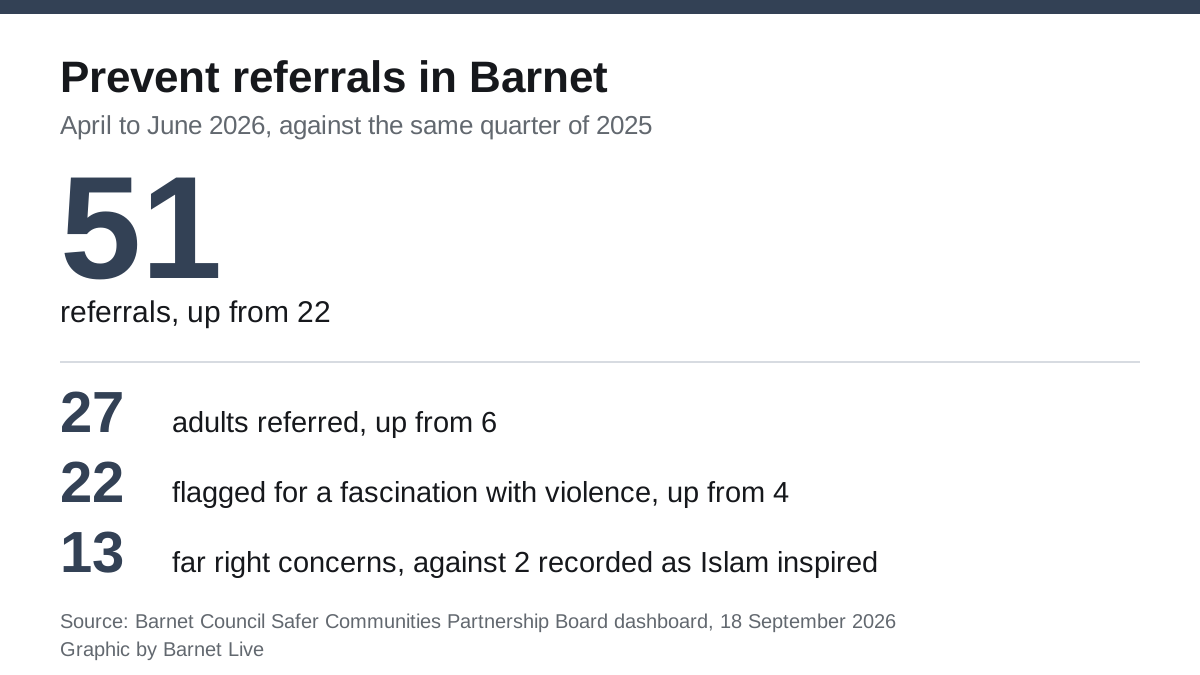

Barnet made 51 Prevent enquiries in April to June, against 22 a year earlier. Adult cases rose from 6 to 27 and violence-fascination cases from 4 to 22.
Barnet received 51 Prevent enquiries between April and June this year, against 22 in the same three months of 2025. That is an increase of 138%.
The figures were put to the borough’s Safer Communities Partnership Board on 18 September, in the same quarterly dashboard that recorded a 64% rise in hate crime in the borough.
Prevent is the strand of the government’s counter-terrorism strategy that deals with people thought to be susceptible to radicalisation. A referral is not an arrest and not a criminal record. Most referrals end there, with no further action.
Who was referred
The quarter’s 51 enquiries break down like this, with last year’s figure for the same three months:
- Under 18: 24, up from 16
- Over 18: 27, up from 6
- Male: 40, up from 19
- Female: 11, up from 3
The shift towards adults is the sharpest change in the table. Adult enquiries rose 350% while those about children rose 50%. A year ago roughly three in four Barnet enquiries were about someone under 18. This quarter it was fewer than half.
What the concern was
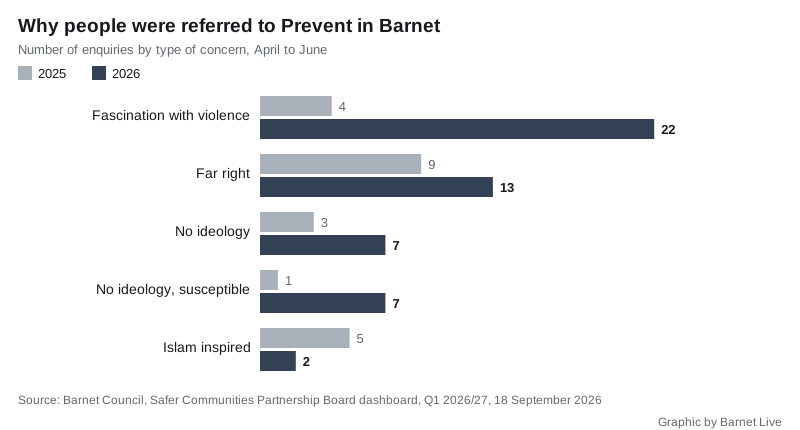
The largest single category was not an ideology at all. Twenty-two of the 51 enquiries were recorded under fascination with violence, against four a year earlier.
- Fascination with violence: 22, up from 4
- Far right: 13, up from 9
- No ideology: 7, up from 3
- No ideology, susceptible to radicalisation: 7, up from 1
- Islam inspired: 2, down from 5
The dashboard explains the two “no ideology” labels. The first covers someone with no clear extremist belief system, who may hold a mixed or unclear worldview and is not necessarily at risk. The second covers someone with no fixed ideology but with vulnerabilities, such as a sense of injustice, low self-esteem, isolation or a need to belong, that could be exploited.
What happens after a referral
Cases that get past screening go to a Channel panel, a confidential multi-agency safeguarding meeting chaired by the council. Support is voluntary and requires consent.
In Barnet the panel meets monthly, with eight core partners and others brought in as a case requires. In April to June the borough’s panel:
- discussed an average of 12 cases at each meeting
- set an average of 23 actions per meeting
- held one extraordinary meeting
- carried out four reviews
How Barnet compares with the national picture
The Home Office’s most recent national statistics, published on 6 August 2026 and covering October 2024 to September 2025, show 9,957 individuals referred to Prevent in England and Wales through 10,293 referrals. That was 39% more referrals than the year before and the highest in a single year since the series began in 2015. So Barnet’s rise is steep, but the direction is not unusual.
The shape of Barnet’s quarter does track the national pattern in one respect. Across England and Wales, extreme right-wing concerns accounted for 20% of referrals where a concern was recorded, against 8% for Islamist extremism. Barnet’s 13 far right enquiries against two Islam inspired is the same imbalance, more sharply drawn.
Nationally, “no ideology” categories made up 56% of referrals. In Barnet the two no-ideology labels together came to 14 of 51, or 27%. What Barnet has instead is that much larger fascination-with-violence group. The Home Office counts a similar category, “fascination with extreme violence or mass casualty attacks”, which peaked nationally at 286 referrals in April to June 2025 before falling back.
One caution on all of this: Barnet’s categories are the council’s own wording on its own slide, and they do not map exactly onto the Home Office definitions. The two sets of figures also cover different periods. Treat the comparison as a rough bearing, not a league table.
What it means for you
Anyone can make a Prevent referral, and you do not have to be sure. Schools, councils, the NHS, prisons and probation are specified authorities under the Prevent duty, which requires them to have due regard to the need to stop people being drawn into terrorism. Parents, friends and neighbours carry no such duty, but they can still ask for advice.
The national route for a worried family member is the ACT Early advice line on 0800 011 3764, or the ACT Early website, run by Counter Terrorism Policing. Calling it is not the same as calling the police about a crime, and it does not start a criminal investigation.
For parents of secondary school pupils in the borough, the number worth noticing is the 24 under-18 enquiries, up from 16. Schools are the biggest single source of referrals nationally. If a school raises Prevent with you, the panel that follows is a safeguarding meeting you can decline to take part in.
About these figures
The Prevent slide in the council’s deck is headed “Q1 2026/27 (Jan 25 to Mar 25)”, which is a stale label carried over from an earlier version. The table on the same slide is headed Q1 2025/26 against Q1 2026/27, and the deck’s cover page states that it covers the three months from April 2026 to June 2026. The category, age and sex splits each add up to 51 exactly, so the quarter’s totals are internally consistent.
Sources
- Safer Communities Partnership Board, 18 September 2026: agenda and papers
- Appendix A: SCPB dashboard 2026-27 Q1 (PDF)
- Home Office, Individuals referred to and supported through the Prevent Programme, October 2024 to September 2025
- Channel and Prevent multi-agency panel guidance
More Barnet information: planning applications, council tax bands, bin collection days.
Have your say