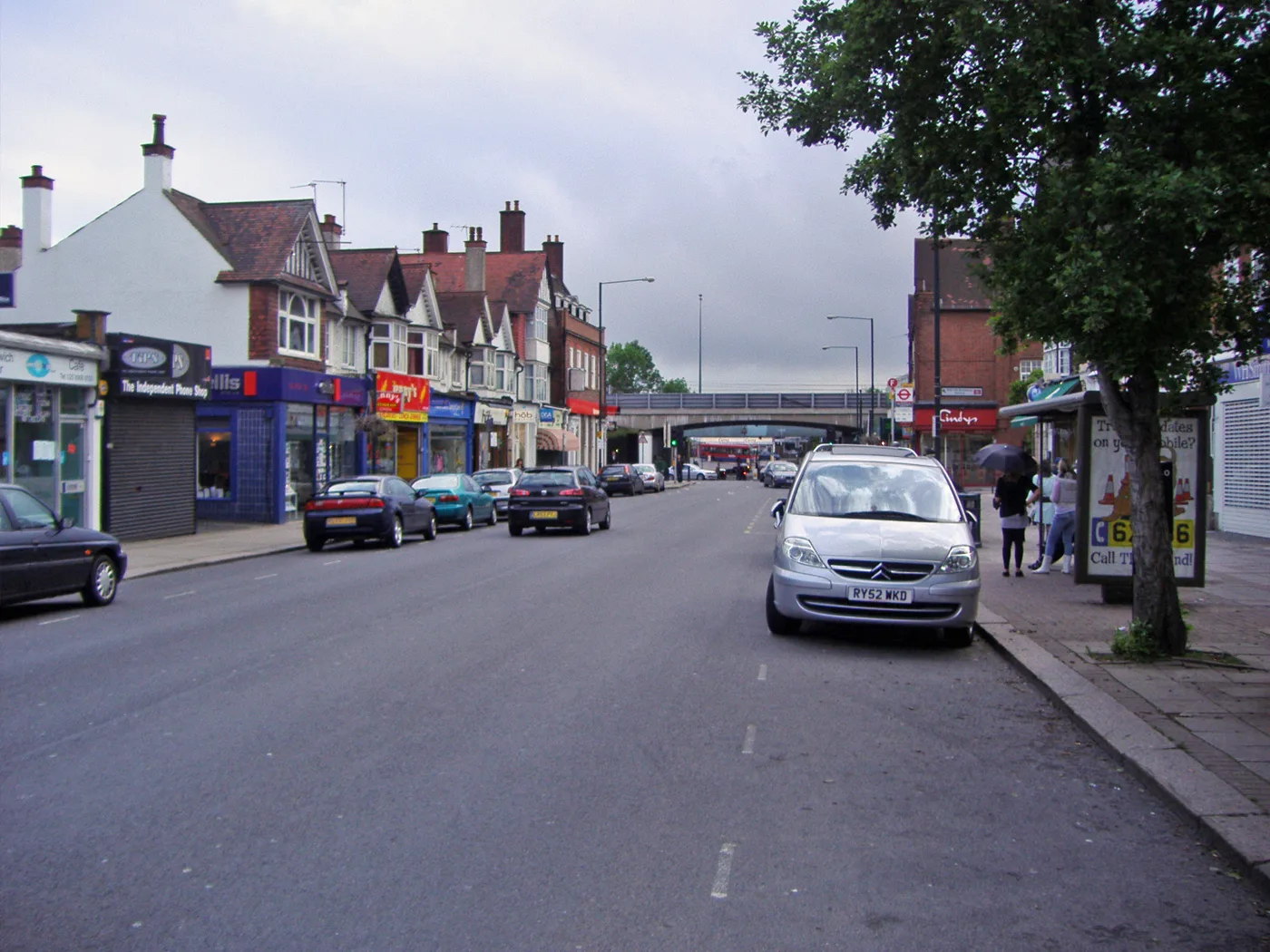

Barnet Council wants timed bin bag collections in seven town centres, including High Barnet and North Finchley. Councillors discuss the plan on Monday 9 November.
Shops and flats above shops in seven Barnet town centres could soon be told to put their rubbish out only during set time slots. Barnet Council says the rule has cleaned up Mill Hill Broadway. It now wants to extend it to seven more places, including High Barnet, North Finchley and East Finchley.
The plan is in a council paper for the Environment Overview and Scrutiny Sub-Committee, which meets at 7pm on Monday 9 November. (Barnet Council, Street Cleansing options paper)
The same paper sets out six ways to change how often residential streets are swept. One of them would end scheduled sweeping altogether.
The seven town centres
Time banding means residents and businesses can only leave bags out for collection within fixed windows. Bins left on the pavement are removed. The paper proposes it for:
- West Hendon (West Hendon ward)
- part of Brent Street (Hendon ward)
- High Barnet (High Barnet ward)
- North Finchley (Woodhouse and West Finchley wards)
- East Finchley (East Finchley ward)
- Childs Hill (Childs Hill ward)
- Deansbrook Road (Burnt Oak ward)
The council says officers from its placemaking, community safety and highways teams agreed the list. Ward councillors have had “early conversations” about it. The time slots for each area have not been published yet.
Why the council wants it
The paper describes the problem plainly. In most town centres, bins and bags “can be presented at any time and left out for long periods”. Bagged waste from flats above shops is often left out overnight. That attracts vermin, the bags get torn open, and litter spreads along the street. It also stains pavements and draws more fly-tipping.
Some of these high streets have no service alley at the back, so the bags have nowhere to go but the pavement.
How Mill Hill and Burnt Oak went
Barnet has tried this twice before. Mill Hill town centre switched to time banding in July 2018 and Burnt Oak in May 2019.
The council’s verdict on each is different:
- Mill Hill: “generally successful”. There are now only “minimal and isolated reports” of rubbish put out wrongly, and the residents’ association reports a cleaner town centre.
- Burnt Oak: “less successful”. Waste is still put out at the wrong times and in bags that cannot be identified, and the council has not always had the enforcement staff to deal with it.
Both areas saw some extra fly-tipping at first, the paper says, because not enough people bought the special sacks and the council had to remove bins that were no longer allowed. Its main lesson is that the scheme needs sustained enforcement and publicity to stick.
What happens next
Nothing changes yet. The Barnet Waste Regulations 2017, agreed by the full council in October 2017, would have to be updated to name each town centre and its time slots. The council says detailed proposals will come back to the same committee, and the committee’s comments go to the Cabinet.
Six options for residential streets
Barnet’s 2,483 residential roads are currently swept on a fixed schedule of two visits a year. The council says 95% of streets due a visit were cleaned to the national Grade B standard in the period to September 2026.
The paper asks councillors to consider six options:
| Option | What it means | Extra yearly cost |
|---|---|---|
| 1. Keep things as they are | Two scheduled visits a year | None |
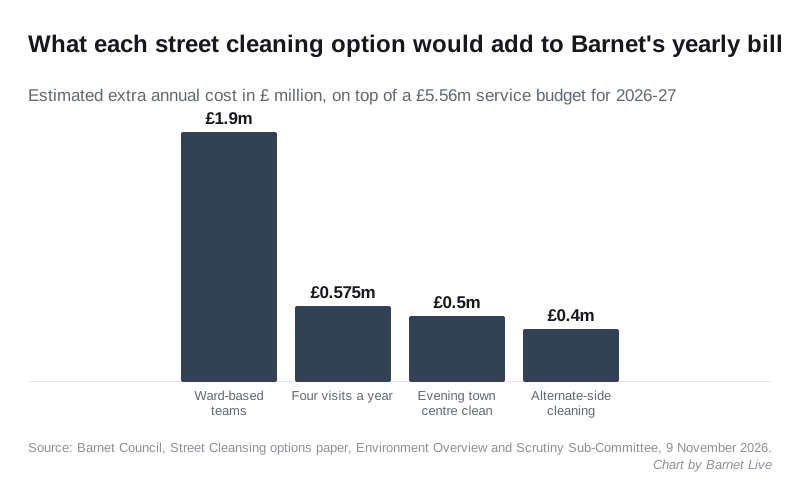
| 2. Four visits a year | 13 more staff and 4 more vehicles | About £575,000 |
| 3. Fully reactive | No scheduled visits; streets cleaned only when reported or inspected | Possible savings, not costed |
| 4. Standards-based | Streets inspected at least four times a year and cleaned when they fall below Grade B | Broadly neutral |
| 5. Alternate-side cleaning | About 200 streets where parked cars block the sweepers; drivers asked to move on set days | About £400,000 |
| 6. Ward teams | At least 48 more staff, assigned to the 24 wards | About £1.9m |
The paper does not formally recommend one. It does say option 4 “incorporates the advantages of other options, while remaining within the current cost footprint”.
It also warns about option 3. If cleaning depends on residents reporting problems, areas where people complain more could get more than their share of the service.
For option 5, the council says enforcement would be needed for drivers who do not move their cars. Barnet ran alternate-side cleaning before, and compliance fell away over time.
A separate costing in the paper puts an evening clean of town centres, on top of the daytime one, at about £500,000 a year.
The money
Street cleaning in Barnet has a budget of £5.56m in 2026-27. About 93 staff are deployed each day. Town centre cleaning is the biggest single cost, at £2.15m a year for 43 staff. Barnet has eight main town centres and twelve secondary ones, each cleaned daily.
The same paper carries the council’s fly-tipping figures for every ward. We have written those up separately: fly-tipping in Barnet, ward by ward.
What it means for you
- If you live or run a business in one of the seven town centres, you may eventually have to put rubbish out only at set times, in council sacks. No dates or slots have been set, and the council says there will be engagement with residents and businesses first.
- If you live on a residential street, how often your road is swept could change. Any change would go to the Cabinet and, the council says, be subject to consultation.
- You can watch or ask a question. Committee meetings are public. The agenda, and how to submit a question, are on the meeting page.
Your regular collection day is unchanged. Check it on our Barnet bin collection days page.
Sources
- Barnet Council, Street Cleansing options paper, report to the Environment Overview and Scrutiny Sub-Committee, 9 November 2026
- Barnet Council, Environment Overview and Scrutiny Sub-Committee agenda, 9 November 2026
Have your say