

London Assembly hears evidence on homes for older Londoners at 10am Thursday 22 October. Barnet has 56,104 residents aged 65+, second most in London.
Whether London’s homes are fit for people growing old in them is the question for the London Assembly’s Housing Committee at City Hall tomorrow, Thursday 22 October, at 10am. The meeting is open to the public and is streamed live.
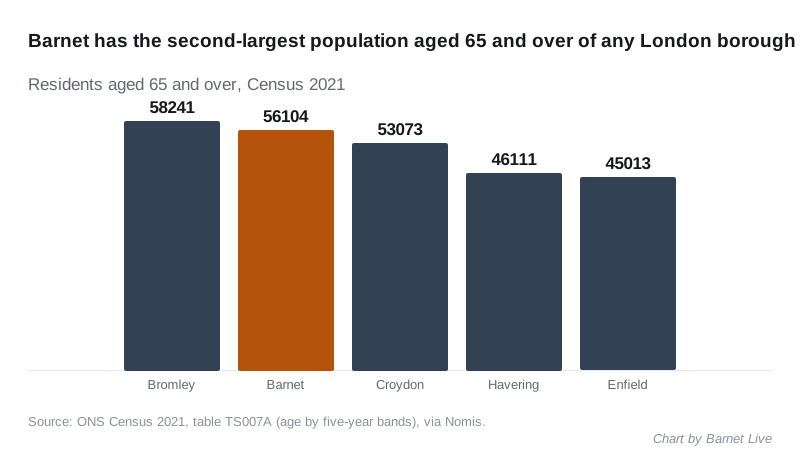
It matters more in Barnet than almost anywhere else in the capital. The 2021 Census counted 56,104 Barnet residents aged 65 and over, 14.4% of the borough’s 389,343 people. Only Bromley, with 58,241, has more (ONS Census 2021, table TS007A, via Nomis). Of Barnet’s older residents, 15,834 were 80 or over, and 8,493 were 85 or over.
The hearing is the first session of a committee investigation into housing for older Londoners, according to the background report for the meeting.
What the committee is looking at
The Assembly says more than 1.05 million Londoners are aged 65 and over, and that the number aged 80 and over is projected to rise by around 336,000 by 2050. That second figure comes from the Mayor’s Towards an age-friendly London evidence base (November 2023), which compares 2050 with 2020.
“Most older people continue to live in mainstream housing, yet much of London’s housing stock was not designed with later life in mind,” the Assembly said in its notice of the meeting.
Members will hear evidence on three things: how well existing homes meet older people’s needs, how hard it is to adapt a home so someone can keep living independently, and whether enough specialist housing is being built.
The committee’s background report sets out the numbers behind the questions:
- Growth. GLA projections put a 57% rise in Londoners aged 65 and over between 2024 and 2051, from 1.1 million to 1.8 million. About 12% of Londoners are over 65 now, against 19% across the UK.
- Where older people live. Nationally, 91% of over-65s live in mainstream housing. The report says research suggests most would rather stay in their current homes, adapted if need be, than move.
- Accessible homes. Just 17% of London homes meet the minimum standard for accessibility, against 13% nationally. The London Plan 2021 said all new homes should meet at least the higher M4(2) accessibility standard; the report says that target is “currently not being met”. The Draft London Plan 2026 repeats the commitment.
- Adapting a home. Renters can struggle to get a landlord’s permission for adaptations. The median cost of bringing an owner-occupied home up to a decent standard is “nearly £6,000”, the report says, and information and support for people who want to adapt their homes is patchy.
- Tenure. At the 2021 Census, 65% of London households aged 65 and over owned their home, 27% lived in social housing and 8% rented privately. The Pensions Policy Institute forecasts that 17% of 65+ households nationally could be renting privately by 2041, and 18% of Londoners aged 45 to 64 already rent privately.
- Specialist housing. Sheltered accommodation is the most common type. Research by the Centre for London in 2021 found the city was building less than half the specialist housing for older people that it needs.
The wider investigation will also look at under-occupancy in social housing, the mix of home sizes being built, and what more the Mayor could do.
Who is giving evidence
Panel 1, 10am to 11.30am: mainstream housing
- Natalie Turner, Deputy Director for Homes and Communities, Centre for Ageing Better
- Martina Kane, Head of Policy and Research, Independent Age
- Professor Julienne Meyer CBE, Professor Emerita of Nursing: Care for Older People, City, University of London, and former Chair of the Older People’s Housing Taskforce
Panel 2, 11.30am to 12.45pm: specialist housing
- Professor Julienne Meyer CBE
- Nick Hodgskin, Director of Regeneration, Anchor
- Michael Voges, Chief Executive, ARCO
The committee is chaired by Lord Bailey of Paddington AM.
What it means for you
If you are older, care for an older relative, or are thinking about whether your home will still work for you in 20 years, this is the session where those questions are put to the people who research and build housing for later life. Anything the committee publishes afterwards will go to the Mayor, who sets London’s housing and planning policy.
- Go in person: the Chamber, City Hall, Kamal Chunchie Way, E16 1ZE, from 10am on Thursday 22 October. The Assembly says members of the public are invited to attend.
- Watch: live or later on the Assembly webcast or the London Assembly YouTube channel.
- Read the papers: the agenda and background report, and the Housing Committee’s page for its wider work.
More on what is happening around the borough is in What’s On in Barnet.
Have your say