
Barnet plans £18.75m of road and pavement repairs in 2027-28, with more for footways. Fixing every worn road would cost £103m. Councillors see it on 9 November.
Barnet Council plans to spend £18.75 million repairing roads, pavements, drains and bridges in the year from April 2027. Pavements get a bigger share than before. The money is still far short of the backlog: the council’s own survey puts the cost of treating every road in poor or fair condition at almost £103 million.
The figures are in a draft Cabinet report on the 2027/28 Improving Barnet’s Roads and Pavements Programme. It is the fourth year of the programme. The council’s Environment Overview and Scrutiny Sub-Committee will look at it at Hendon Town Hall at 7pm on Monday 9 November, before Cabinet decides in December.
Where the £18.75m goes
The council is putting in £16.10 million. That is part of the £97 million it set aside for roads in 2024/25, later spread over six years. The other £2.65 million is a forecast of government highways money. Of that, £1.65 million is baseline funding and £1.01 million is incentive funding that Barnet only gets if it passes a series of Department for Transport tests, including publishing an annual transparency report.
| Work | 2027/28 budget |
|---|---|
| Road resurfacing and patching | £10.0m |
| Pavement resurfacing and patching | £5.0m |
| Drainage | £1.0m |
| Preventative treatments, including Roadmender | £1.0m |
| Other assets: rubber crumb paths, signs and lines | £0.65m |
| Reactive repairs top-up | £0.6m |
| Bridges and other structures | £0.5m |
| Total | £18.75m |
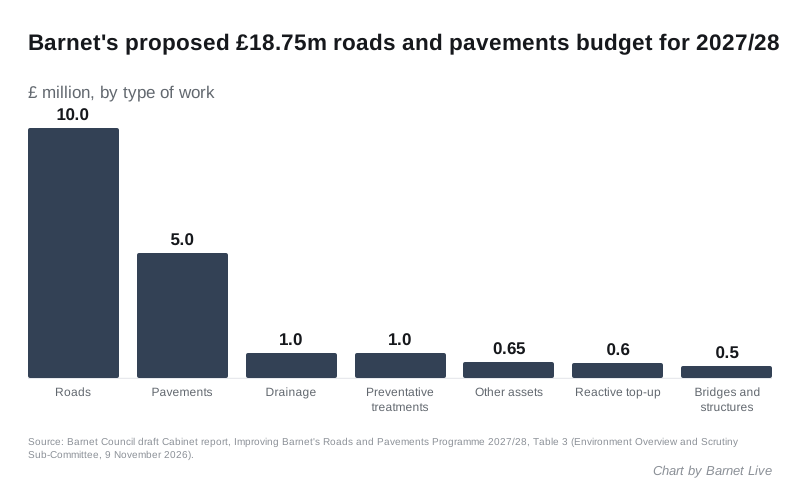
Within the £10 million for roads, £4.75 million is for resurfacing residential streets and £4.5 million for resurfacing main roads. Pavement resurfacing gets £3.5 million and pavement patching £1.5 million.
Pavements get more, roads stay level
The report says all pavement work, including the rubber crumb programme, comes to £5.35 million, up from £3.75 million this year. The stated aim is better access for people on foot. The council also says it uses insurance claims data to spot where older people are falling, because falls feed one of its biggest social care costs.
All road work, counting patching, reactive repairs and Roadmender, comes to £11.6 million. That is about the same as this year’s £11.5 million.
The report warns that the budget does not allow for contract inflation or the rise in National Insurance. Both will be reviewed during 2027/28.
The backlog
Barnet’s network is 723km of road, of which 96km are main roads, and 1,290km of pavement. The council values it at £2 billion.
Consultants Xais-PTS surveyed every council road and pavement in 2026. Their figures for what it would cost to put things right:
- £102,938,163 to treat every road rated red or amber
- £57,037,998 to rebuild every pavement rated red
- £64,984,709 for pavements rated amber
The survey found the network “stable”, with no real change between 2024 and 2026. Main roads improved slightly. Residential roads showed “a very slight increase” in the red category.
So at this rate of spending, Barnet is holding its roads roughly where they are, not clearing the backlog. The report says that is the plan: it matches the “sustained position” option Cabinet chose in March 2024.
How a street gets picked
The pavement survey ran from March to September 2026. A high-definition 360-degree camera was mounted on a mobility scooter, and AI software scored the damage in each 10-metre stretch. A stretch counts as defective when 15% or more of its surface is cracked or worn.
- A pavement resurfacing scheme needs at least 100 metres of defective stretches in a row.
- A pavement patching scheme needs at least 50 metres.
- Roads were surveyed by inspectors driving the network in March and April 2026.
Each scheme is then scored on its condition and on risk: how busy the road is, how many defects inspectors have logged, how rough the ride is, and whether there is a school, hospital or place of worship nearby.
The street list is not out yet
The list of streets due for work, Appendix A, is marked “Not available” in the scrutiny papers. The report says ward councillors have been briefed on it. Residents will be told before work starts on their road. If a community objects to a scheme, the Director of Highways and Transportation can change the programme without going back to Cabinet.
Low-carbon roads
In March 2026 the council and its contractor Marlborough Highways resurfaced three streets with low-carbon materials, Appendix D says. They were Hammers Lane NW7, Wessex Way NW11 and Sydney Road N10. The mix used a warm asphalt called SuperLow, a carbon-negative aggregate called ACLA and recycled asphalt, laid with electric rollers and vans.
The council’s figures say the scheme’s footprint fell from 62.34 tonnes of CO2 equivalent to 4.49 tonnes, a cut of more than 92%. It plans to keep using these methods where money and materials allow.
It also plans a borough-wide trial in 2027/28 of cheaper treatments for roads that are worn but still sound, such as retexturing, surface dressing and rejuvenation sprays, Appendix C says.
What it means for you
- Want to know if your street is included? The list is not public yet. It should come with the Cabinet papers in December. Your ward councillors have seen it.
- You can speak at the scrutiny meeting. The 9 November agenda has an item for public comments and questions. Details are on the meeting page.
- Expect pavement work. The biggest change is the extra money for footways.
- Works this winter are on our Barnet roadworks page, updated each week.
The draft Cabinet report gives the meeting date as 17 December, while its scrutiny cover sheet says 15 December. We will check the date once the Cabinet agenda is published.
Have your say