
A government-commissioned review gives Barnet until September to act on council tax and alternate weekly bins. It forecasts the deficit reaching £243.5m by 2030-31.
An independent review commissioned by the government has told Barnet Council to review its council tax level and to move to alternate weekly bin collections. Both recommendations carry a deadline of September 2026.
The review was carried out by the Chartered Institute of Public Finance and Accountancy in April, and published by the Ministry of Housing, Communities and Local Government on 18 August. It runs to 43 pages.
Barnet did not choose to have it. The council asked the government for Exceptional Financial Support, and the review was a condition of getting it.
The two recommendations residents will feel
Of the review’s recommendations, two land directly on households. Both carry a risk rating of 9, the highest the review uses. Its scoring multiplies likelihood by impact, so a 9 means a risk judged probable and critical.
- Recommendation 4 tells the council to build “a realistic, prioritised and deliverable savings plan, including a review of the level of Council Tax”, with named accountable officers, by September 2026.
- Recommendation 12 tells it to prioritise a smaller number of high-impact reforms, naming temporary accommodation, children’s placements, adult social care and “alternate weekly bin collection”, by September 2026.
The review is blunt about why it is raising both. It says the evidence shows “savings fatigue” and points to “deferral of difficult decisions, such as the council’s previous approach to council tax increases and the introduction of alternate weekly waste collection”.
What alternate weekly would mean here
Barnet currently collects both the black refuse bin and the blue recycling bin every week, with separate weekly food waste since 30 March 2026. Alternate weekly means one of those bins would be collected every other week instead.
The review says waste costs are “moderately above comparators and recycling performance below” stronger London and national benchmarks. Its verdict on the service is that it is a “functional service but efficiency and policy choices require review”.
The council is not resisting the idea. It is “already planning to push up recycling rates next year by looking at fortnightly waste collections”, and cites a cross-party recommendation to reach 50% recycling under the North London Joint Waste Strategy. That is from Cllr Simon Radford, Barnet’s Cabinet Member for Financial Sustainability, writing on 25 August.
Our Barnet bin collection days page sets out the service as it stands today.
What the council tax recommendation is actually about
This is not a proposal to raise your bill by a third, and the arithmetic is worth doing carefully.
A Band D home in Barnet pays £2,132.60 in 2026/27. Of that, £1,622.09 is Barnet Council’s share and £510.51 is the Greater London Authority precept, which Barnet does not control. Every figure below refers only to the council’s share.
- Barnet’s budget assumes a rise close to the legal maximum of 5%, which the council says would take its share to £1,703.
- The government’s assumed, or “notional”, level for Barnet is £2,060.
- The difference between those two is £357 a year on a Band D home.
Cllr Radford described the notional level as “an increase of over 30%”. The council did not publish the base it used for that percentage. Measured against the £1,622.09 charged this year, £2,060 is £437.91 more, or 27%.
Anything above the 5% cap needs either government permission or a referendum. The review acknowledges this, saying that although “Barnet’s Band D council tax is significantly low, generating additional income through increases of this scale is limited by the requirement for a referendum along with local political acceptability”.
Every band for the current year is in our Barnet council tax bands guide.
The numbers behind it
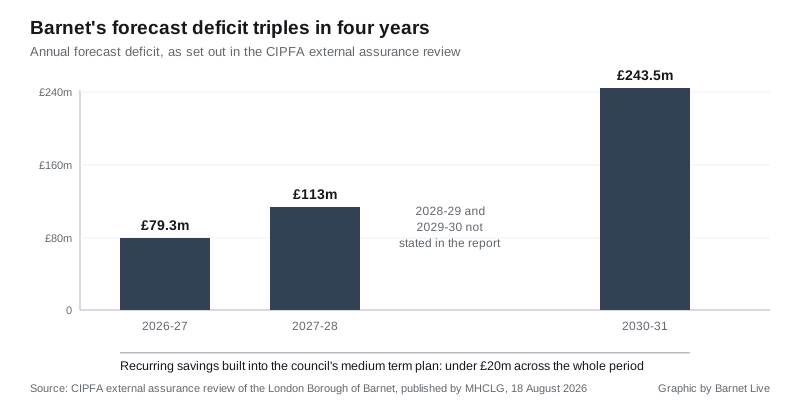
The review’s central finding is that the gap is widening faster than the savings. It states that forecast deficits are “increasing from £79.3 million in 2026-27 to £243.5 million by 2030-31, while recurring savings built into the MTFS total less than £20 million over the same period”.
Elsewhere the report puts the 2027-28 figure at £113 million, describing deficits as “rising from £113 million in 2027-28 to £243 million by 2030-31”. It does not state the 2028-29 or 2029-30 figures.
Other figures from the report:
- General Fund reserves stand at £15 million, about 3.2% of the net revenue budget, with a separate financial resilience reserve of £11.3 million. The review notes these are “considerably less” than the projected deficit for 2026-27 alone.
- Barnet’s 2025-26 budget was balanced using £55.7 million of Exceptional Financial Support. In December 2025 it asked for a further £79.3 million for 2026-27, revised down from an earlier £88.4 million after the final local government finance settlement.
- The capital programme “exceeds £1bn” across the medium-term period.
- The council carries £404 million of service investment loans, of which £296 million relates to Open Door Homes.
- A separate review by Peopletoo found indicative savings opportunities of £45 million to £61 million, but the report says many “remain conceptual, subject to validation or not yet fully incorporated into deliverable transformation plans”.
The review is not uniformly critical. It records that governance arrangements are “structurally sound”, that inspection outcomes in adults’ and children’s services are positive, and that the January 2025 Care Quality Commission assessment rated the council “Good” for adult social care. Its criticism of leadership is about pace: a culture it calls “cautious and consensus-driven”, which “has slowed the pace of difficult decisions”.
What the council says
The council’s own framing differs from the report’s in one respect worth noting. Cllr Radford refers throughout to a “£200m structural deficit” to be closed by March 2029. The review’s own forecast runs further out, to £243.5 million by 2030-31.
Cllr Radford’s main defence is that the review looks backwards. It “focuses on our position two years ago (2024-25)”, he said in the council’s response on 18 August. He listed three things he says have changed since:
- council spend has been brought under control
- the call on Exceptional Financial Support has been cut by £10 million
- in-year spending on temporary accommodation has been stabilised
He also set out the limit of what the council can do alone: “Even if we were to cut all non-statutory spend, the short-term impact would be an £18m budget reduction compared to the £200m forecast gap.”
What it means for you
- Nothing changes on your bins yet. Collections are weekly today. The council has said it is “looking at” fortnightly collections for next year; no date, no consultation and no decision has been published.
- Nothing changes on your bill yet either. The 2026/27 charge is set. The decisions this review is pushing land in the 2027/28 budget.
- The date to watch is 12 October. Cllr Radford has said the council’s plan for reaching financial sustainability by March 2029 goes to Cabinet that day.
- Expect to be asked. The council says it will start “an open and honest conversation with residents in earnest after the summer holidays”, and describes the decisions ahead as “very painful”.
Have your say