
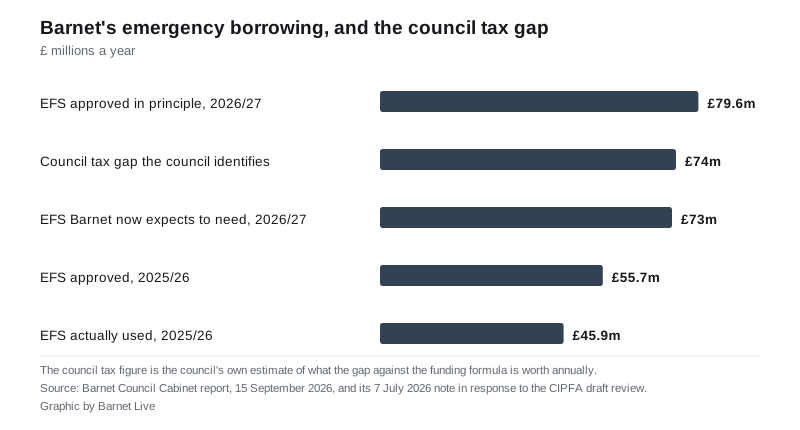
The council puts the gap between what Barnet pays and what the formula assumes at about £74m a year. It is borrowing £79.6m in emergency support this year.
Barnet Council has asked the government to say plainly how high it expects council tax in the borough to go, and has put a figure on the gap: about £74 million a year.
The request is in a note the council’s chief executive and chief finance officer sent to CIPFA and the Ministry of Housing, Communities and Local Government on 7 July. It was published for the first time on Tuesday 15 September, as an appendix to a Cabinet report.
The note says ministers have already been clear, through the funding formula, what they expect residents in each council area to pay at Band D. What Barnet wants to know is the trajectory:
In relation to Council Tax, it would be helpful to understand the parameters considered by civil servants in making recommendations to Ministers in accordance with the EFS framework. Ministers have been clear through the funding formula what they expect residents in each Local Authority area to pay in Council Tax (Band D), and it is important to understand what factors are considered in agreeing an appropriate trajectory to that level. For Barnet this is worth approximately £74m annually.
Why £74m is a large number here
Barnet is running on exceptional financial support, which is government permission to borrow to cover day-to-day spending. The Cabinet report sets out the scale:
| Year | Exceptional financial support | Actually used |
|---|---|---|
| 2025/26 | Up to £55.7m approved | £45.9m |
| 2026/27 | Up to £79.6m approved in principle | Council now expects about £73m |
Set the council’s own £74m council tax figure against those numbers and the comparison is uncomfortable. The gap the council has identified between what Barnet residents pay and what the funding formula assumes they should pay is roughly the same size as the emergency borrowing the council is relying on to balance this year’s books.
What a Barnet household pays now
A Band D home in Barnet pays £2,132.60 in 2026/27. That splits into:
- £1,622.09 to Barnet Council
- £510.51 to the Greater London Authority
Our Barnet council tax bands page carries the figure for every band.
The council has not said what level the funding formula assumes, and the note does not name one. It asks the question rather than answering it, which is the point: the council is telling the ministry that it cannot plan a trajectory it has not been given.
The review it is responding to
The note was written in response to the draft of a CIPFA external assurance review, commissioned by the ministry as a condition of the exceptional financial support. The final version was published on 18 August and makes 18 recommendations.
The first of them, risk rated nine out of ten with a September 2026 deadline, tells the council to develop a realistic, prioritised and deliverable savings plan “including a review of the level of council tax”. We set out the review’s recommendations when it was published, in our report on the review.
Where the council pushes back
The 7 July note is not only a question. It is also the council’s argument that the review judged it on the wrong year. It says the council was “somewhat disappointed” that much of the report focuses on 2024/25 and does not acknowledge the progress evidenced during 2025/26, and that several statements, “while accurate in a narrow sense, present the situation as static rather than evolving”.
The evidence it offers includes:
- 2025/26 outturn broadly to budget, £460.035m against a budget of £472.810m
- 96% of planned savings delivered in 2025/26
- emergency support use cut by nearly £10m against the in-principle approval
- the head of internal audit giving “reasonable assurance” for 2025/26
- draft accounts published a day ahead of the statutory deadline on 29 June 2026
On the review’s warning about more than £400m of exposure through companies and service investments, the council’s answer is that £300m of it is lending to Opendoor Homes, its own wholly owned housing company, which used it to build and buy homes, and which services the debt from rents. It calls that “a necessary mechanism, outside of the stretched HRA, to reduce temporary accommodation costs”.
On temporary accommodation itself, the note reports the amount in use falling from a peak of 3,112 to 3,036 in May 2026, while adding that it is too early to say the reduction plan caused it. It also says the unit costs of both nightly and block-booked emergency accommodation are still rising, with the overall figure down only because more of the cheaper block-booked type is being used.
The council also disputes the review’s phrase “cautious leadership culture”, and asks whether it refers to councillors, officers or both, and how much of it was simply the point in the electoral cycle.
What the government has already said about the parameters
The council says it wants to understand the factors civil servants weigh when recommending council tax flexibility. Two of them are already published, in the government’s response to the Fair Funding Review 2.0.
Paragraph 9.2.8 sets out when a council can be allowed to raise council tax above the referendum limit. The government says it will consider requests “where a local authority is facing significant local financial difficulty and views additional council tax increases as critical to managing financial risk”, case by case, and that it “will not agree to requests for additional flexibilities from authorities where council taxpayers are already paying above the average bill”.
Barnet is below that line. The England average Band D for 2026/27, excluding parish precepts, is £2,343.40. Barnet’s Band D bill is £2,132.60, and the borough has no parish precepts, so a Barnet Band D household pays £210.80 less than the England average.
Paragraph 9.4.16 is the other half of it. Protection through funding floors, the government says, “assumes local authorities use the full council tax flexibility available to them”. Keeping council tax low does not protect a council’s grant; the formula assumes the money was raised whether or not it was.
Put together, those two paragraphs explain why a review commissioned by the ministry told Barnet to review the level of council tax, and why the council is now asking how far it is expected to go.
What happens next, and when
Cabinet did not vote on whether to accept the recommendations. The minutes record that it noted the review and the council’s response, authorised the chief executive and section 151 officer to send progress reports to the ministry at the end of September 2026, and agreed that future updates would come through the chief finance officer’s quarterly report.
The substantive document, Our Plan for Financial Sustainability, goes to Cabinet in October 2026.
What it means for you
No council tax decision has been taken, and none can be until the budget is set early next year. Nothing on your bill changes because of this note.
What it tells you is where the pressure is coming from. The council is not volunteering a council tax rise; it is asking the department that controls its emergency borrowing what level it is expected to reach, and it has quantified the gap at around £74m a year.
The parameters it says it wants explained are partly on the record already, and they do not favour Barnet. As the section above sets out, the government has said it will consider requests to go above the referendum limit case by case, and that being below the average bill is what keeps such a request in play at all.
Two dates matter. The progress report to the ministry is due at the end of this month, and it is not a public document unless the council chooses to publish it. The October Cabinet paper is, and that is the one that should show what the council intends to do about council tax, savings and reserves together.
Sources
- Appendix B, LB Barnet notes in response to the CIPFA draft review, 7 July 2026, for the council tax passage, the £74m figure, the 2025/26 outturn and savings figures, the Opendoor Homes lending and the temporary accommodation numbers
- Cabinet report, MHCLG External Assurance Review, 15 September 2026, for the exceptional financial support figures, the 18 recommendations and their deadlines
- Barnet Council, Cabinet agenda, reports and minutes, 15 September 2026, item 9, for what Cabinet resolved
- Appendix A, Barnet External Assurance Review 2026
- Government response to the Fair Funding Review 2.0, paragraphs 9.2.8 and 9.4.16, for the council tax flexibility test and the funding floor assumption
- MHCLG, Council tax levels set by local authorities in England, 2026 to 2027, published 25 March 2026, Table 1, for the England average Band D of £2,343.40 excluding parish precepts
- Band D figures for 2026/27 as set out on our Barnet council tax bands page
Have your say