
Barnet Council approved the switch on 4 August: the Hendon Islamic primary becomes voluntary aided this September. Fees go, voluntary contributions stay.
A fee-paying Islamic primary school in Hendon joins the state system in a fortnight. Barnet Council approved the proposal to establish Barnet Hill Academy as a voluntary aided maintained primary school on 4 August 2026, the school says on its own voluntary aided information page. The decision was taken under the School Organisation (Establishment and Discontinuance of Schools) (England) Regulations 2013, and the council’s decision notice carries the detail.
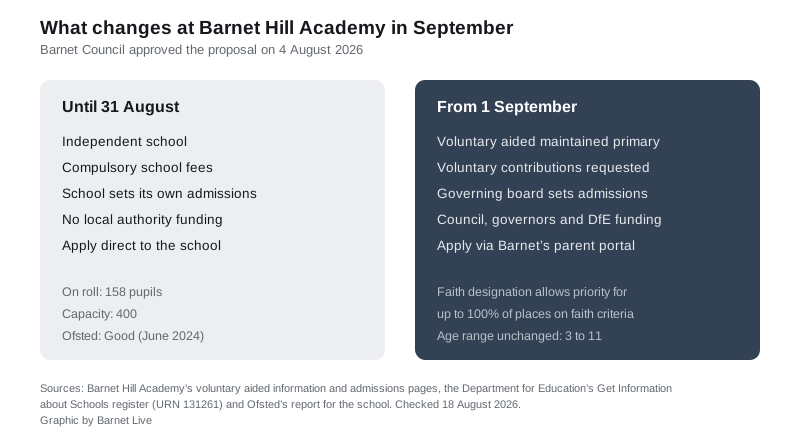
The school is at 10a Montagu Road, NW4, and has been open since 9 February 2006. The Department for Education’s register of schools still lists it as an independent school, with 158 pupils against a capacity of 400, an age range of 3 to 11 and a religious character of Islam. Its headteacher is Shuayb Patel. Ofsted last inspected it on 11 June 2024 and rated it Good, up from Requires Improvement at the previous standard inspection in 2022.
What actually changes
A voluntary aided school is, in the school’s own words, “maintained by the local authority, but where the governing board of the school employs staff and implements the admissions criteria”. Funding comes from a mix of the council, the governing body and the Department for Education.
Faith designation matters here. The school says the designation means its governing board can:
- give priority for up to 100% of school places on faith-based admissions criteria
- appoint teachers by reference to faith
- provide religious education and collective worship according to the tenets of the faith
It will keep teaching the National Curriculum. The school also notes that faith-designated voluntary aided schools have “additional freedoms” around religious education, PSHE and relationships and sex education.
The fees do not disappear entirely
This is the part worth reading twice. Compulsory fees go, but the school is asking parents to keep paying.
Its own page says government funding “will not cover the full cost of our students’ education”. It says “fee contributions are needed” to support the Islamic Studies curriculum and its staffing. It puts the consequence plainly: “without financial support from parents through voluntary fee contributions, we risk having to cut back on the very things that make our school exceptional.”
Contributions are also described as “a critical part of the running costs”. The school lists maintenance of facilities and resources, and capital spending the council cannot fund. No amount is published on the page.
Once the school is maintained, the Department for Education’s rules bite. Its charging for school activities guidance says nothing in law stops a governing body asking for voluntary contributions. It then sets limits:
- the governing body or head teacher “must also make it clear to parents that there is no obligation to make any contribution”
- “education provided during school hours must be free”, including materials, equipment and transport
- parents “must not be made to feel pressurised into paying as it is voluntary and not compulsory”
- children whose parents are unable or unwilling to contribute “may not be discriminated against”
How to apply, and by when
The school sets out a two-step process.
For a place in Reception to Year 6 during 2026/27, which is an in-year application:
- Apply online through the Barnet Council parent portal.
- Complete a Supplementary Information Form and hand it in to the school office in the first week of September 2026.
For Reception in September 2027, applications go through the pan-London eAdmissions system, which the school says opens on 1 September 2026.
You do not have to live in Barnet. For children already attending who live outside the borough, the school says the demand or proximity factor will not apply when places are allocated. After that, “so long as places are available, children outside of Barnet are free to apply”.
Priority goes to “children of practising Muslim families, defined broadly as one where the parents are regular attendees of mosques, and whose principles and practices are in accordance with the mainstream Ahl-al-Sunnah doctrine”. The school says that priority is judged on what an applicant puts in the Supplementary Information Form.
What it means for you
If cost has been the reason your child could not attend, that barrier has gone in its compulsory form. Go in with your eyes open about the contribution request and ask the school for a figure before you commit.
If you are applying, the September date is the one that bites: the supplementary form is due in the first week of term, and eAdmissions for Reception 2027 opens on 1 September. Skip the supplementary form and you lose faith priority, because the school judges that criterion on the form alone.
There is room. The register records 158 pupils in a school built for 400, so this is not a conversion into an oversubscribed school. Bear in mind that places are allocated year group by year group, not out of that spare capacity as a whole.
We could not open the council’s own decision notice today: barnet.moderngov.co.uk returned a block page to every request we made. The decision date and the regulations above are as the school records them. If the council publishes its notice in a readable form we will link it here.
Barnet’s wider primary admissions arrangements, including the appeals timetable, sit on the council’s school admissions pages.
Sources
- Barnet Hill Academy, voluntary aided information and FAQs, for the 4 August 2026 decision, the definition of a voluntary aided school, the faith designation and the voluntary contributions
- Barnet Hill Academy, voluntary aided admissions, for the two-step application, the September deadlines and the faith criteria
- Get Information about Schools, Barnet Hill Academy (URN 131261), for the address, opening date, age range, roll, capacity, religious character and headteacher
- Ofsted, Barnet Hill Academy inspection reports, for the June 2024 Good judgement and the inspection history
- Department for Education, Charging for school activities, for the rules on voluntary contributions at maintained schools
- Barnet Council decision notice, reference 9873, as cited by the school. Not reachable from here on 18 August 2026
Related: Barnet council tax bands and Barnet planning applications.
Have your say