

Vaping rates are not collected by borough, the Assembly heard on 4 November, so no one can say how many Barnet children vape. Shop licences are on the way.
Nobody can say how many of Barnet’s children vape. “Vaping prevalence isn’t available at borough level,” Kirsten Watters, Children and Young People’s Lead for the London Association of Directors of Public Health, told the London Assembly’s Health Committee at City Hall on Wednesday afternoon.
The gap matters here because a new licensing scheme for every shop selling vapes will be monitored and enforced by local authorities and their Trading Standards teams, which in this borough means Barnet Council. Barnet did not come up by name during the session, so what follows is the London picture and what it means for families and shops here.
Kirstie Soar of the National Centre for Smoking Cessation and Training said the only national data most boroughs lean on, from the charity Action on Smoking and Health (ASH), is “not a big enough sample” to drill down locally. “We don’t have the data to base any of those decisions on,” she said of how boroughs spend money and design services.
What the figures do show
ASH’s 2026 survey of 2,926 children across Great Britain found 19 per cent of 11 to 17-year-olds had tried vaping and 6 per cent currently vape. Regular use, more than once a week, stands at 4 per cent, and 2 per cent vape every day. Among those who have ever vaped, 45 per cent said they did so “just to give it a try”. The Assembly also cites 46 per cent of current vapers putting taste first when choosing a vape, the figure in the survey’s chart; the text beside that chart says 42 per cent.
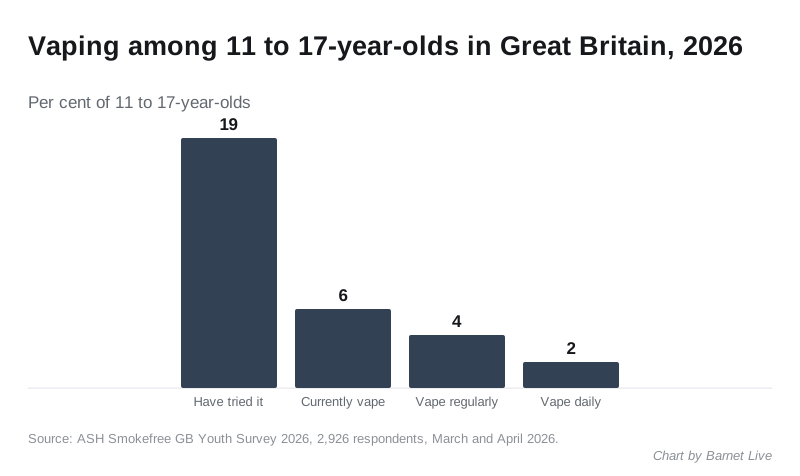
Selling vapes to under-18s is illegal, yet 47 per cent of current vapers in the survey buy them from shops, and 77 per cent say they are easy to get. Most, 72 per cent, were given their first one.
Callum Delhoy of London Youth passed on what his organisation’s youth board had said about shops near schools. Many businesses, one member told them, “were more than happy to forgo age checks” as long as the young people “weren’t wearing their school uniforms”, even though the owners had seen them in uniform before.
At the committee’s first session in September, London Trading Standards said just over 500 test purchases across the capital in 2025/26 produced a failure rate of just under 17 per cent. A one-off national review by the Chartered Trading Standards Institute found illegal sales on 33 per cent of 422 attempts.
“No safe limit” on the illegal vapes
Witnesses separated regulated vapes from the illegal market, and said children mostly cannot. “Once they come out of the packet it’s pretty much impossible to tell,” Soar said.
Assembly Member Caroline Russell put figures to the committee of 2.4 times the safe level of lead, 9.6 times for nickel and 6.6 times for chromium in unregulated vapes. Asked about the harm, Watters said: “There is no safe level for lead at all.” Written evidence to the committee cites University of Bath research that tested 1,923 vapes and e-liquids taken from 114 schools in England and found the synthetic cannabinoid spice in 13 per cent of samples, and in around a quarter of those from London and Lancashire.
For a sense of scale, Watters had asked her own team that morning. Between April and September, Camden seized 2,000 illicit vapes, she said. Barnet’s figure was not given.
Isolation, or help
Witnesses were critical of what can happen when a child is caught. “I don’t think they should take a punitive approach,” Soar said of schools. “If they’re vaping in the toilets there’s a reason why they’re vaping in the toilets, which probably means that they’re in nicotine withdrawal, so just taking a vape away from them and putting them in isolation is not going to address what’s going on.”
Young people from the Tower Hamlets Anti-Vaping Youth Forum, a group of 15 to 18-year-olds working with Barnardo’s, said much the same. “Nobody starts vaping because they consciously want to get addicted to it,” one told the committee. “Punishing children doesn’t help quit it, but rather it helps us want to hide it even more.” Another said it would be harder for them to buy paracetamol in a store than to buy a vape, and wanted Challenge 25 age checks upheld “in the smaller shops”.
Fatima Hydara, Barnardo’s participation lead on the project, said the forum wants “information, not scare tactics”, and a dedicated service for under-18s rather than support attached to adult stop-smoking services.
Help for those who want to stop is patchy. Soar said there are “no standard protocols” for vaping cessation, while Watters said there are “inconsistencies in offer across London”. Boroughs cannot use the ring-fenced stop-smoking money for young people’s vaping services, she said; they come out of the general public health grant.
Soar also warned of side effects from the Tobacco and Vapes Act, passed in May. She expects it to cut experimenting, but said the most dependent young people could turn to illicit markets or back to cigarettes.
What it means for you
- If your child’s school finds a vape: there is no standard route, and Watters said she imagined approaches differ from school to school. Ask what the school’s policy is and whether it offers support as well as a sanction. Soar said most young people can stop unaided or with behavioural support, and that a minority may need nicotine replacement, some of which is licensed for over-12s.
- If you work in a school and keep finding illegal vapes: Watters’s advice was to contact your director of public health, who can link you with Trading Standards for targeted inspections.
- If you think a shop is selling to children: email Barnet Trading Standards or use the London Trading Standards report form. The same team took action against a Hendon shop last month over knife sales to 15-year-olds.
- If you run a shop that sells vapes: the licence is coming, but the Assembly’s own paper says the scheme is subject to consultation and implementation times are not clear.
What happens next
The committee’s chair, Krupesh Hirani AM, was given authority to agree any findings with party group leads, and the Assembly says it will work with the London Youth Assembly on its recommendations. He has also written to the Met Commissioner asking what the force is doing to seize illicit vapes, with a reply requested by 13 November. Watters said research with young people, commissioned by London’s directors of public health to produce resources for boroughs, will be published later this year.
Have your say