
Ofsted graded the Colindale school Expected standard in all seven areas. Its disadvantaged pupils outscored the national average for all pupils at GCSE.
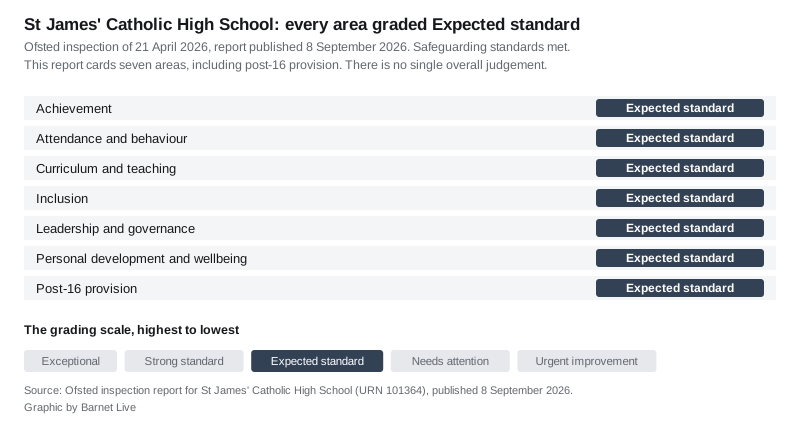
Ofsted has graded St James’ Catholic High School in Colindale at the expected standard in all seven areas of its report card, and confirmed that the school’s safeguarding standards are met.
The report for the school, URN 101364, was published on Monday 8 September. It follows a full inspection on 21 April 2026, the school’s first graded inspection since 2017. Its previous visit, in May 2022, was an ungraded one that found it continued to be a good school.
The school is on Great Strand, NW9, in Barnet’s Colindale North ward. It is a Roman Catholic secondary in the Archdiocese of Westminster, mixed, ages 11 to 18. It had 1,254 pupils on the roll when inspectors visited, against a capacity of 1,400, and Ofsted’s provider page now lists 1,243. The headteacher is Anthony Ellul and the chair of governors is Anthony Kamara.
What the grades mean now
Ofsted has replaced the single overall judgement with a report card that grades each area separately on a five-point scale. “Expected standard” is the middle grade of the five. Ofsted defines it as fulfilling the standard set out in statutory and non-statutory legislation and the professional standards expected.
The results behind the grades
The most striking figures in the report are the ones for disadvantaged pupils, meaning those eligible for free school meals at any point in the last six years and children looked after.
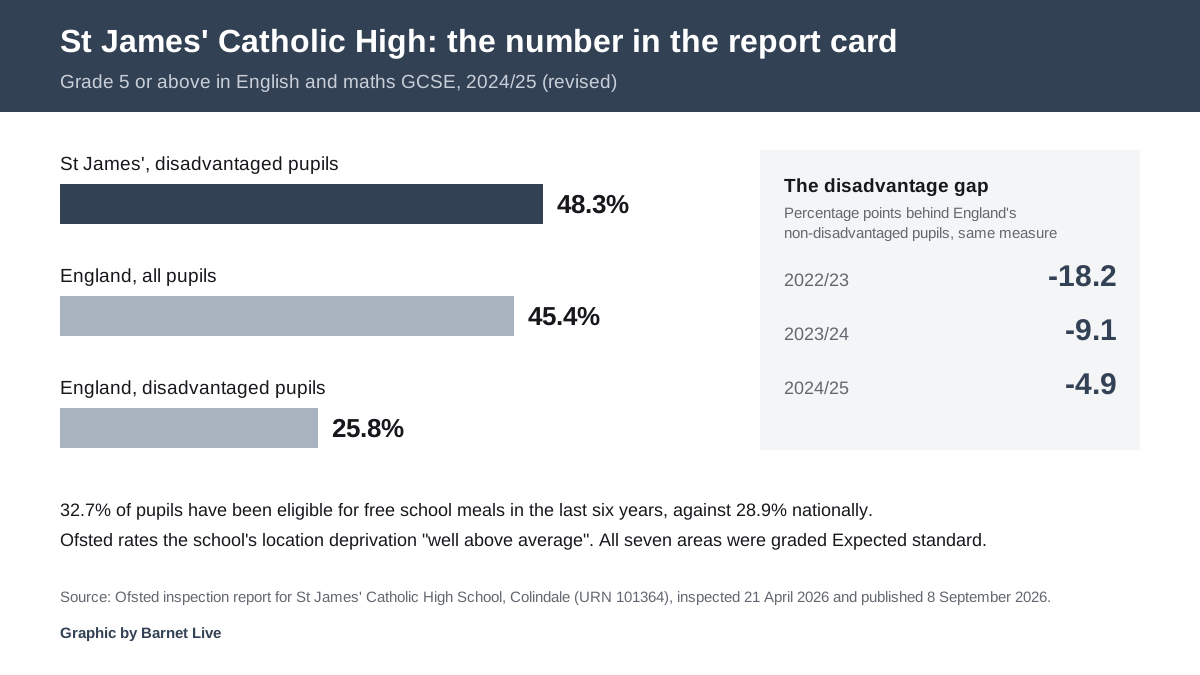
In 2024/25, 48.3% of the school’s disadvantaged pupils achieved grade 5 or above in English and maths GCSE. The national average for disadvantaged pupils is 25.8%. The national average for all pupils is 45.4%, so the school’s disadvantaged cohort scored above the national figure for everyone.
The gap between them and England’s non-disadvantaged pupils has closed sharply:
| Year | School’s disadvantaged pupils | Gap to national non-disadvantaged |
|---|---|---|
| 2022/23 | 34.2% | -18.2 points |
| 2023/24 | 44.0% | -9.1 points |
| 2024/25 | 48.3% | -4.9 points |
That is happening at a school where 32.7% of pupils have been eligible for free school meals in the last six years, against 28.9% nationally, and where Ofsted rates the location deprivation “well above average”.
Across all pupils, 55.8% got grade 5 or above in English and maths in 2024/25, against 45.4% nationally. Attainment 8 was 51.4 against 46.0. Progress 8, last published for 2023/24, was 0.32 against a national -0.03. Ofsted marks each of those as above average. Of the 2023 leavers, 96% stayed in education or employment for at least two terms.
Two measures sit closer to the middle. A-level average points per entry were 32.66 in 2024/25 against a national 34.99, which Ofsted marks as close to average, and A-level value added was -0.1 against 0.0. Inspectors wrote that sixth-form students “achieve in line with their peers nationally when completing their A levels and also do well in vocational subjects”.
Absence is improving. Overall absence was 7.1% across the first two terms of 2024/25 against 8.1% nationally, down from 9.8% in 2022/23. Persistent absence fell from 32.7% in 2022/23 to 17.9%.
What inspectors said needs work
The report is not a straight endorsement. Inspectors set two next steps:
- teachers should check pupils’ understanding more precisely, so that pupils who are ready can move on to more ambitious subject content
- leaders should keep evaluating the personal development offer, so that pupils fully embrace the school’s values and develop more responsibility, resilience and confidence
The same theme runs through the graded sections. Inspectors found that “some pupils are capable of further success and higher outcomes” and are not always moved on when ready. They noted that some pupils need extra reminders about conduct “at social times and around the school site”, and that in the sixth form “societies and clubs are not fully established”.
On the positive side, they recorded that suspensions are declining, bullying is rare, alternative provision is used carefully, and staff “are overwhelmingly proud to work at the school”. Support for pupils with special educational needs and disabilities was judged largely effective, though at times “not as precise as they could be”. The school makes use of two registered alternative provisions.
The inspection was led by His Majesty’s Inspector Sarah Saunders with four team inspectors.
What it means for you
If you are choosing a secondary school in Barnet this autumn, the practical points are these.
- “Expected standard” is not the old “requires improvement”. It means the school is meeting the standard, with two named areas to work on. There is no single headline grade to compare with a school inspected before the change.
- The school had 1,254 pupils and room for 1,400 at the time of inspection, so it is not full on paper. Places still go through Barnet’s coordinated admissions round, and a Catholic school applies its own faith-based oversubscription criteria.
- If your child is eligible for free school meals or has SEN support, the outcome data here is unusually strong for the cohort, and Ofsted graded inclusion at the expected standard.
- Ofsted normally inspects every four years, and carries out monitoring inspections where an area is graded “needs attention” or “urgent improvement”. Neither applies here.
The school’s own website still carried its 2022 “Good” badge on 10 September, with no statement about the new report. The full report is on Ofsted’s site and runs to eight pages.
For the borough’s other recent report card, see Moss Hall Junior School in Finchley, and for this summer’s exam round, A-level results across Barnet.
Have your say