
Barnet refused 463 homes at Stoney Wood Quarter on eight grounds. The Mayor took the decision off the council, and comments are open until 27 September.
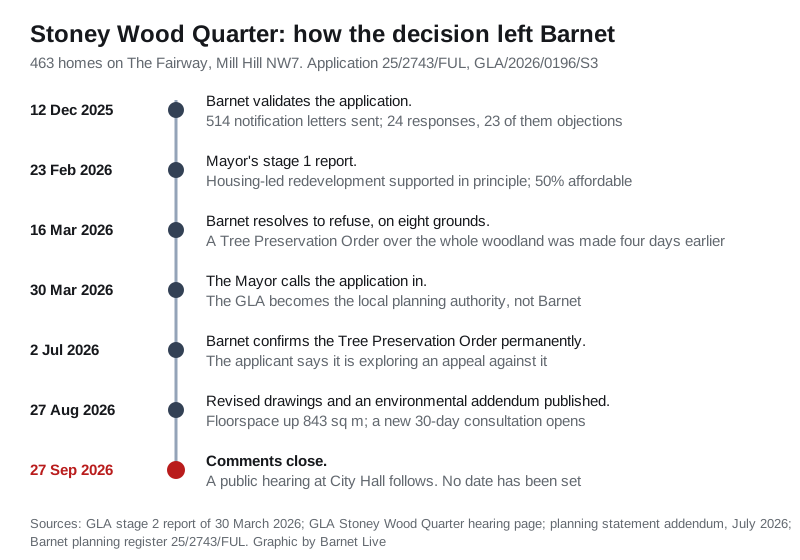
Barnet Council no longer gets to decide whether 463 flats are built in Mill Hill. The Mayor of London took the application off the council in March. The first public consultation since that happened opened on 27 August and closes on 27 September 2026 (GLA).
The scheme is Stoney Wood Quarter, The Fairway, NW7 3HJ. It is a build to rent development of up to 463 homes in buildings of up to six storeys, with ancillary amenity and commercial space, new public squares and play space. Barnet’s own register carries it as application 25/2743/FUL, still marked pending decision. The applicant is Stoney Wood Property Developments Ltd.
The site is not a green field. The developer’s own project website says it sits on the grounds of a demolished school, next to the Fairway and Northway schools, and is currently used as a car storage facility after years of fly-tipping. Behind it are woodland and Stoney Wood Lake (Stoney Wood Quarter).
Barnet said no on eight grounds
The council resolved to refuse permission on 16 March 2026, under delegated powers. Its draft reasons are reprinted in full in the Mayor’s stage 2 report, which Barnet has published on its own planning register (GLA stage 2 report). There were eight of them:
- excessive density, massing and unresolved site edges, failing to respond to the suburban character of the area
- a poor standard of accommodation for future residents, on space, outlook, daylight, privacy and tranquillity
- inaccurate and insufficient information on plans, air quality, noise, commercial floorspace, drainage and refuse
- insufficient and unreliable information on highways, parking and servicing
- no justification for departing from the housing mix required by the Barnet Local Plan
- unacceptable loss of protected trees and priority woodland covered by a Tree Preservation Order
- insufficient information on biodiversity and protected species, including bats, badgers and reptiles
- no legal undertaking to secure the planning obligations
Two weeks later the Mayor stepped in. On 30 March 2026 the Deputy Mayor for Planning issued a direction under Article 7 of the Town and Country Planning (Mayor of London) Order 2008. That direction makes the Greater London Authority the local planning authority for this application. Barnet is now a consultee on a site inside its own borough.
Why the Mayor intervened
The stage 2 report sets out the test. The Mayor can only take over an application if it would have a significant impact on delivering the London Plan and there are sound planning reasons to intervene.
On the first limb, the report says the 463 homes would be 19.5% of Barnet’s annual housing target on their own. The 212 affordable homes would be 0.5% of the whole capital’s annual affordable housing target.
On Barnet’s record, the report is blunt about the numbers. The borough’s annual target is 2,364 homes. Completions averaged 2,145 a year over the preceding five years, about 219 a year short.
The affordable housing is 50% by habitable room, which is the threshold for the fast-track route because the land is public. The GLA records the tenure split as 70% discounted market rent and 30% London Living Rent. There is no social rent in that split.
The row about the woodland
The trees are the sharpest disagreement in the file, and the timing is the reason.
The council made a Tree Preservation Order over the entire woodland four days before it resolved to refuse permission, and confirmed the order permanently on 2 July 2026. The applicant’s planning statement addendum says in terms that it believes the council made the order “to bolster the reasons for refusal”, that it asked for a copy of the council’s tree assessment and did not receive one, and that it is exploring whether it can appeal the order (planning statement addendum, July 2026). That is the applicant’s characterisation, not a finding by anyone.
The same document puts numbers on the loss. Chartered arboriculturists assessed every tree on the site. The scheme removes 79 trees or groups of trees and retains 71. Valued by the CAVAT method, the trees to be removed are worth £263,262 and the replacement planting £50,097. The shortfall of £213,065 would be paid to the council through the legal agreement.
Biodiversity is the other unresolved point. The GLA report records that the proposals would produce a net loss of 16.12% in habitat units and 46.62% in hedgerow units, which does not comply with the London Plan. The Environment Agency raised no objection but warned that construction could harm the ecological value of Dean’s Brook, which runs at the site.
What the neighbours said
Barnet sent 514 notification letters. It received 24 responses: 23 objections and one in support. The objections covered amenity, consultation, density, design, drainage, local transport, the natural environment and open space.
Mill Hill Preservation Society objected, calling the proposal overdevelopment in an inappropriate location with insufficient public transport, and raising architecture, congestion, parking and construction logistics. Councillor Lachhya Gurung objected on parking and the lack of public services. The single supporting comment backed the principle of redeveloping a vacant site, along with the design and density.
Statutory consultees were more relaxed. Affinity Water raised no objection in principle. So did the Environment Agency, subject to two conditions, and Historic England’s Greater London archaeology service, subject to conditions. Natural England raised no objection. The Metropolitan Police’s Secure by Design team raised no objection and recommended a condition, while its estates team said the development’s impacts would need to be mitigated.
What the developer is offering
The heads of terms for the legal agreement, as set out in the July addendum, include:
- an NHS health infrastructure (HUDU) contribution of £343,200
- a carbon offset contribution of £360,603, subject to change
- the £213,065 tree shortfall payment, plus off-site biodiversity credits
- £250 per home towards a controlled parking zone feasibility study, and restrictions on residents’ parking permits
- a private shuttle bus, or a contribution towards the TfL bus network
- a 20% local labour target, one apprenticeship for a Barnet resident for every £2m of build cost, and one work experience placement on the same ratio
The applicant also says GLA officers have considered Barnet’s reasons for refusal “are not justified” and that clarifications and minor layout changes have overcome them. Again, that is the applicant’s account of officer discussions, not a decision. The changes it has actually made are small: internal layouts, facade detail, less cycle parking, more plant space and a different split between residential and commercial floorspace. Total floorspace rises by 843 square metres.
What it means for you
The decision will be made at a public representation hearing at City Hall, chaired by the Deputy Mayor. No date has been set. Anyone who comments will be written to at least 21 days beforehand and can ask to speak at the hearing. That is the practical reason to comment now even if you have already objected to Barnet: comments made to the council are still counted, but only people on the GLA’s list get told when the hearing is.
The deadline is 27 September 2026. Comments go to the GLA’s consultation page for the scheme (Have Your Say) or by post to The Planning Team, Greater London Authority, City Hall, Kamal Chunchie Way, London E16 1ZE.
One warning if you want to read the paper file. The two official notices do not agree on where it is. The statutory notice published in the local press says hard copies can be inspected between 8.30am and 5.30pm, Monday to Friday, at City Hall in Kamal Chunchie Way (Public Notice Portal). The GLA’s own web page for the scheme says 10am to 4pm, Monday to Friday, at 169 Union Street, SE1 0LL, with appointments outside those hours on 07702 825 054. Ring first. The documents are also on the London DataStore.
If the scheme is approved, the developer’s published timeline targets a start on site in winter 2026 and first residents in 2028 or 2029. The same timeline records that the agreement with Barnet Council to deliver the build to rent project was finalised in autumn 2023 (Stoney Wood Quarter timeline).
For the wider picture on how many homes Barnet is being told to build, see our report on the draft London Plan housing target. Other live applications across the borough are listed on our Barnet planning applications page.
Have your say