
Barnet has the biggest ten-year housing target of any London borough in the draft plan: 32,730 homes, 7,000 in the Green Belt. Comment by 15 October.
Barnet has been given the largest ten-year housing target of any London borough in the Mayor’s draft new London Plan, and 7,000 of those homes would come out of the Green Belt.
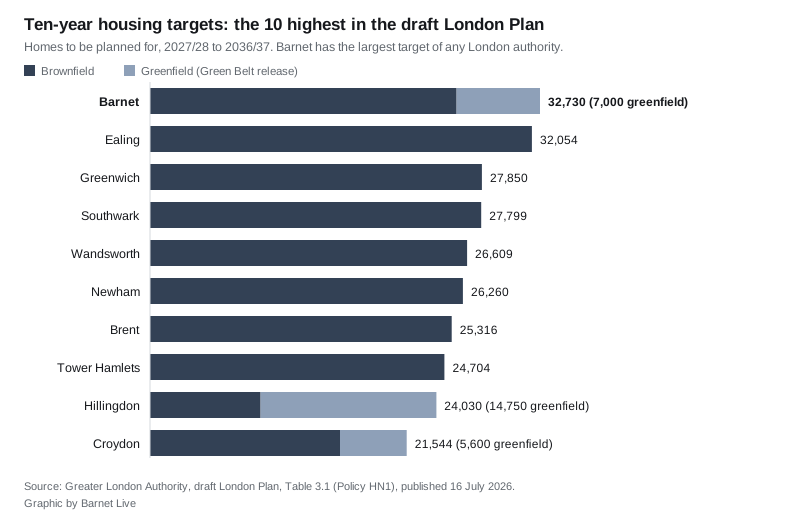
Table 3.1 of the draft plan, under Policy HN1 Increasing London’s housing stock, sets Barnet a target of 32,730 homes between 2027/28 and 2036/37. That is 3,273 a year. It splits into:
- 25,730 homes on brownfield land
- 7,000 homes on greenfield land
No other London planning authority is given a higher total. Ealing is second on 32,054, Greenwich third on 27,850.
The policy is not advisory. It tells plan-making authorities they “should … adopt and plan for the individual ten-year housing targets set out in Table 3.1”, and separately plan for capacity towards 850,000 homes across London by 2047.
The consultation on the draft plan closes at 5pm on Thursday 15 October 2026. Anyone can respond through the GLA consultation portal, on the whole plan or on single chapters.
What changed for Barnet
Barnet’s target under the current London Plan 2021 is 23,640 homes over ten years, or 2,364 a year. The draft raises that to 32,730, an increase of 9,090 homes, or 38.5%.
London’s own total rises far less: from 522,870 to 558,451, up 6.8%. Barnet therefore absorbs about a quarter of the entire London-wide increase.
The borough also moves up the table. Under the 2021 plan Barnet had the fourth highest target, behind Tower Hamlets, Newham and Greenwich. Under the draft it is first.
Nearby boroughs, 2021 plan against the draft:
| Borough | 2021 plan | Draft plan |
|---|---|---|
| Barnet | 23,640 | 32,730 |
| Enfield | 12,460 | 21,062 |
| Brent | 23,250 | 25,316 |
| Haringey | 15,920 | 19,030 |
| Harrow | 8,020 | 12,010 |
| Camden | 10,380 | 12,085 |
The Green Belt part
Barnet is one of only eight London planning authorities given a greenfield component at all. The other seven are Hillingdon (14,750), Havering (12,060), Enfield (7,000), Croydon (5,600), Redbridge (5,400), Harrow (3,150) and Barking and Dagenham (1,140). Barnet’s 7,000 is joint third with Enfield.
Across London greenfield land accounts for 10% of the target. In Barnet it is 21%.
The draft plan names where that growth is meant to go. Its ten-year key diagram, in chapter 2, lists “Mill Hill and Barnet” as location 59 in a category called Broad Locations for Growth: Green Belt Residential-led Mixed Use. The same chapter says that for those locations, “the Green Belt release associated with those BLGs is acceptable in principle because it is necessary to meet objectively assessed needs for homes and employment-generating uses”.
Two other things in the chapter matter locally:
- Brent Cross, Cricklewood and Staples Corner is listed as a Brownfield First Opportunity Area, one of 37 across London. That is where much of the 25,730 brownfield figure is expected to come from.
- The M1 (Borehamwood West Area) and the A1 (Borehamwood East Area) appear as Green Belt industrial locations on Barnet’s northern edge, the second as a “future candidate”.
The plan also puts a brake on the Green Belt element for the first three years. Paragraph 3.13 covers authorities that have a greenfield component. For 2027/28 to 2029/30 their housing requirement is set at the annualised brownfield target only. The plan gives the reason as “the lead-in times for delivery in Green Belt locations”. It adds that under-delivery on brownfield land “should not be off-set at the local level by planning for increased delivery on greenfield land”.
The other targets in the same chapter
Table 3.1 is not the only Barnet number in the housing chapter. Over the same ten years the draft plan also asks the borough for:
- 2,127 purpose-built student bedspaces (Table 3.6), the highest figure of any London authority
- 16 additional permanent Gypsy and Traveller pitches (Table 3.4)
- 130 transitional and 80 long-term supported housing units, plus 1,170 older people’s housing units for 2025 to 2035 (Table 3.7)
What it means for you
Nothing is decided. The draft plan now goes to consultation, then to an independent Examination in Public, and the GLA expects adoption in early 2028. No Green Belt boundary changes on the ground until Barnet’s own Local Plan is reviewed to match.
What is live is the consultation. If you want a say on the total, on the Green Belt release at Mill Hill, or on where the brownfield homes go, the deadline is 5pm, Thursday 15 October 2026, through the GLA portal. You can respond to a single chapter rather than the whole document. Chapter 3 covers housing and chapter 2 covers the Green Belt locations.
Meanwhile the ordinary decisions carry on. Current applications are on our Barnet planning applications page. What the borough’s homes are actually selling for is on our Barnet house prices page.
Sources
- Draft London Plan, chapter 3: Delivering the homes and neighbourhoods Londoners need (Tables 3.1, 3.4, 3.6, 3.7 and Policy HN1)
- Draft London Plan, chapter 2: Making best use of land and achieving Good Growth (key diagrams and Broad Locations for Growth)
- Draft London Plan consultation, Greater London Authority
- The London Plan 2021, chapter 4: Housing (Table 4.1)
Have your say