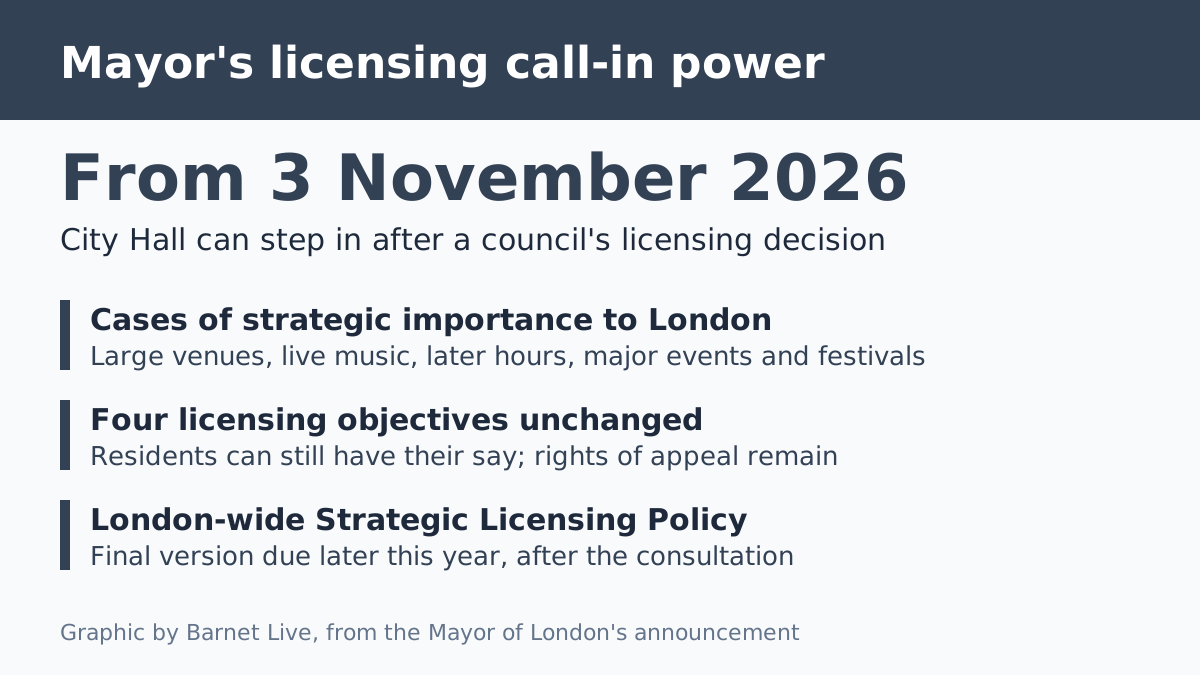

From 3 November Sadiq Khan can call in licensing bids for large venues, live music, later hours and festivals after Barnet's decision, and make the final call.
A licensing decision made by Barnet Council’s licensing committee is no longer necessarily the last word. From Tuesday 3 November, the Mayor of London can call in licensing applications he judges to be of strategic importance to the capital and make the final decision himself.
City Hall says it is the first time a UK mayor has been able to decide a licensing application directly. The power was granted by the Government, and Sadiq Khan called it “a new era for London’s nightlife”.
What the Mayor can now do
According to City Hall, the Mayor can step in after a local licensing decision has been made and decide whether to approve an application that “can be defined as strategically important” to London’s economy and its reputation as a global city. The examples it gives are applications for:
- large venues
- live music
- later opening hours
- major events and festivals
The power only applies to applications that meet the Government’s criteria, City Hall says. It has not said how often it expects to use it, or named any application it is looking at.
For Barnet, that means a contested application for a big venue, a late licence or a festival in the borough could be decided at City Hall after the council’s own committee has ruled on it. The announcement concerns venues, music, late hours and events; it does not mention gambling premises, such as the Golders Green and Edgware slots licences that Barnet’s licensing sub-committee hears on the same day.
What stays the same
City Hall says keeping people safe and protecting local communities “will remain at the heart of licensing”. The four licensing objectives are unchanged: preventing crime and disorder, public safety, preventing public nuisance and protecting children from harm.
Residents will still be able to have their say on applications, the impact on different communities will still be considered, and rights of appeal remain in place, according to the Mayor’s office.
The other new City Hall roles
The call-in power is the latest of several new roles the Government has given the Mayor over licensing. City Hall lists them as:
- councils, including Barnet, must consult the Mayor when they revise their licensing policies
- City Hall receives every licensing application and can make formal representations to licensing committees
- the Mayor must publish a London-wide Strategic Licensing Policy
A public consultation on the draft Strategic Licensing Policy ran earlier this year. The Mayor is now considering the responses and says he will set his final policy later this year. City Hall says the aim is a licensing system that is “consistent and supportive of London’s culture, hospitality, events and nightlife”.
City Hall puts the value of London’s nightlife at more than £21bn a year to the capital, and says the sector has faced “inconsistent licensing rules and complex processes”.
What the Mayor said
Sadiq Khan said: “Today is a hugely significant moment and marks the beginning of a new era for London’s nightlife.
“As Mayor I have always tried to be pro-jobs and pro-business and I’m determined to build on this. These new licensing powers create an opportunity to further champion London’s amazing venues, particularly our hospitality industry.
“From today, thanks to the Government, I can step in and make decisions on licensing applications of particular importance for our economy, reputation and nightlife, allowing me to back the venues that make our high streets and communities thrive and help cement our city’s nightlife reputation, while keeping people safe and listening to communities.
“I’m looking forward to setting a new direction for our capital’s life at night, creating a more strategic and consistent approach to licensing.”
The Mayor marked the change with a visit to a London music venue alongside Angela Rayner, the Secretary of State for Housing, Communities and Local Government, who said: “Nightlife is about so much more than a good night out. The musicians on stage, the staff behind the bar, the small businesses that depend on them, that’s jobs, that’s growth, and a big part of what makes London the world-famous city it is.
“So, we’re giving the Mayor of London historic new powers over licensing decisions that have the biggest impact on the capital. It’s about backing the venues and events that keep London buzzing.”
What the industry said
Kate Nicholls, chair of UKHospitality, said the sector already employs half a million Londoners. “I was pleased to lead the Government’s licensing sprint which recommended these changes and it’s encouraging that some of the most significant are being introduced so swiftly,” she said.
Mark Davyd, founder and chief executive of the Music Venue Trust, said: “This is a significant step forward for live music across the capital, offering the opportunity for a consistent, robust, and constructive licensing process.”
Michael Kill, chief executive of the Night Time Industries Association, said: “For too long, outdated and fragmented licensing processes have held back investment, innovation and growth across the capital’s night-time economy. The Mayor’s new powers offer a real opportunity to restore confidence, protect our cultural infrastructure and unlock the potential of a sector that is vital to London’s economy, identity and global reputation.”
Earlier this year the Mayor put nearly £500,000 into dining and events across London through his Summer Streets Fund, City Hall says, and an independent Nightlife Taskforce he set up made recommendations across 10 areas.
More on the Mayor’s wider economic plan is on the London Growth Plan page.
Have your say