

Barnet now has 96 foster households, down from 119 in 2021, and more of its children in care live with agency carers than its own. School attendance and jobs are up.
Barnet has 23 fewer foster families than it did five years ago. The number of households fostering for the council fell from 119 in 2021 to 96 in 2026, and the number of approved foster places fell from 208 to 151.
The figures are in the council’s annual report on children in its care, published for Cabinet on Tuesday 17 November. (Barnet Council, Corporate Parenting Annual Report 2025-26)
The report calls finding homes for children “one of the most significant strategic challenges facing Barnet”. The same report shows real gains in school attendance and in young people getting into work or training.
The key figures
On 31 March 2026 the council was responsible for:
- 352 children in care, including 44 who arrived in the UK alone as asylum seekers
- 330 young adults who had left its care
During 2025/26, 186 children came into care, up from 162 the year before. Abuse, neglect and exploitation now account for 65% of children entering care. Arrivals of children seeking asylum rose from 33 to 41.
More children with agency carers than Barnet’s own
Of the 352 children, 104 were living with foster carers found through independent agencies. Only 69 were with Barnet’s own foster carers. In all, 61% of children were in placements the council buys from outside providers.
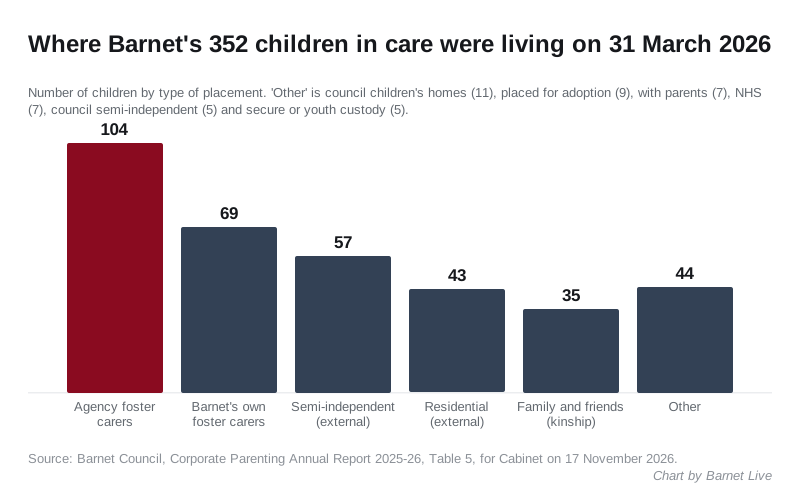
The report says interest is not the problem. Fostering enquiries rose to more than 300 in 2025/26. But few of those became approved carers, and not enough to replace experienced carers who left.
It also says the children coming into care have changed. More are teenagers, more have been exploited, and more need carers with training in trauma. That has meant “greater reliance on external placements and increased placement costs”.
The share of children who had lived with the same carer for at least two years fell from 74% in 2024 to 63% in 2025. The report links that to the shortage of local placements. The share moving home three or more times in a year stayed between 9% and 11% over five years.
What went well
The report lists several improvements in 2025/26:
- school attendance for children in care rose from 86.6% to 89.2%
- persistent absence fell from 27.3% to 21%
- no child in care was permanently excluded
- young people not in education, employment or training fell from 25% to 17.7%
- 98% of care leavers were living in suitable accommodation
- 83 care leavers were offered a secure social housing tenancy, including 11 young parents given two-bedroom homes
Ofsted made a focused visit to the leaving care service in November 2025. The report says inspectors found “strong leadership, effective practice” and good support for independent living.
More children are also staying with relatives. Special guardianship orders, which let a grandparent, aunt or family friend raise a child permanently, rose from 10 to 23 in a year.
What it means for you
Barnet is trying to recruit more foster carers through the North London Fostering Hub, a joint recruitment drive with five other councils. The annual report says recruiting and keeping local carers is a priority for 2026/27.
If you have thought about fostering, the hub’s site, Foster North London, takes enquiries for Barnet. People who rent can foster, but you need a spare bedroom. Our fostering hub story sets out who can apply and what carers are paid.
Cabinet will be asked to note the report and send it to Full Council. The meeting is at 7pm on Tuesday 17 November at Hendon Town Hall, and the papers are on the council’s meetings site.
Have your say