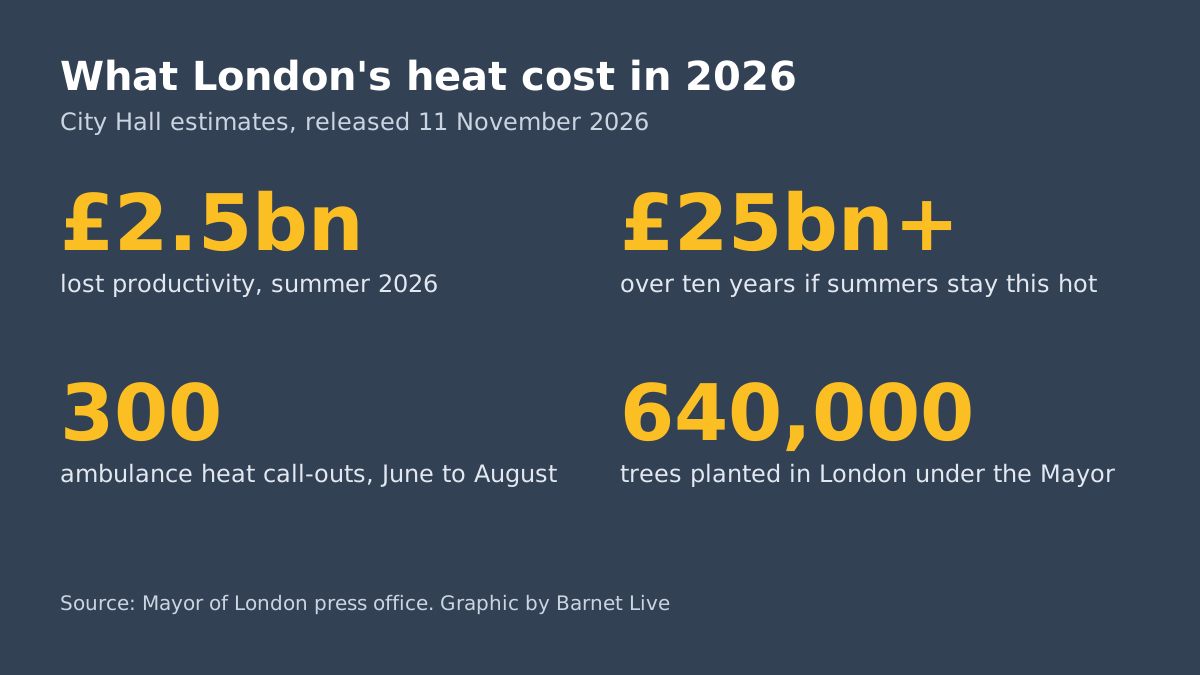

City Hall puts the cost of London's 2026 heatwaves at about £2.5bn in lost work, and over £25bn in ten years if they continue. Sadiq Khan takes it to COP31.
This summer’s heatwaves cost London around £2.5 billion in lost productivity, City Hall estimated on Wednesday 11 November, and if summers like it become the norm the bill could pass £25 billion over the next ten years. That is more than the Mayor’s entire annual budget for London, and Barnet’s share sits inside both figures.
The Mayor of London, Sadiq Khan, is taking the estimate to COP31, the United Nations climate conference in Antalya, Türkiye. City Hall says he will be the first Mayor of London to speak at the World Leaders’ Summit, a slot usually reserved for heads of state and government leaders.
What it means for Barnet
City Hall has not broken the figures down by borough. What it has described is a London-wide plan that runs through the boroughs: Heat Ready London, produced with London Councils and published this summer. Its priorities include reducing overheating in homes and essential public buildings, protecting frontline workers and creating more shade, with health services, emergency responders, transport providers and utilities working to one plan.
The early warnings are already reaching Barnet. City Hall points to its warning systems for heat and air quality as world-leading, and the same system put out the high air pollution alert that covered Barnet on Tuesday 10 November.
Families feel it too. Earlier research cited by City Hall found that heat-related school closures during the 2022 heatwaves cost London parents nearly 60,000 working days and an estimated £9.4 million in lost earnings.
Where the £2.5 billion comes from
City Hall’s estimate draws on research into London’s 2022 heatwaves, updated with this summer’s temperature data and adjusted for inflation. The cost is lost productivity: high temperatures make it harder for people to work effectively.
The emergency services had a record summer:
- London Ambulance Service crews attended 300 heat-exposure incidents between June and August, more than three times the five-year summer average. It was the service’s busiest summer on record.
- London Fire Brigade firefighters and control officers answered nearly 100,000 emergency calls between May and August.
The death toll was wider. Research from Imperial College London and the London School of Hygiene & Tropical Medicine estimates that more than 50,000 people died from heat-related causes in European urban areas this summer, about two-thirds of those deaths attributed to human-induced climate change. Imperial College London also estimates more than 4,000 excess deaths across 135 urban areas in the UK this summer. Figures from The Lancet, quoted by City Hall, put heat’s contribution to deaths worldwide at more than 700,000 in 2023.
What the Mayor will tell world leaders
City Hall says more than 640,000 trees have been planted across London under the current Mayor, shading streets from the summer sun, and more than 2,000 football pitches’ worth of green space has been created or improved. It says making buildings cooler will need public money, private investment and support from national government.
In his speech, the Mayor is expected to say: “The climate sceptics argue that these investments are unaffordable. But the only thing we cannot afford is to do nothing. Because, even if you can see past the devastating implications for human health, the long-term economic impact of extreme heat alone will be astronomical. If the scenes we saw this summer became the standard, it could cost London’s economy more than £25 billion over the next ten years.”
He is also expected to say: “Climate disaster is no longer the stuff of some distant dystopia. It’s killing people, harming communities and impacting our economies right now.”
As co-chair of C40, a network of almost 100 cities, he says the aim is for every member city to have early warning systems by the end of 2027. “But these systems can never be a substitute for tackling the root causes of the climate crisis,” he is expected to add.
What the ambulance, fire and health chiefs said
Jason Killens, chief executive of London Ambulance Service, said: “This was a record-breaking summer for both the UK and London Ambulance Service. As the capital sweltered, our colleagues across the organisation worked tirelessly to respond to more 999 calls and Category 1 incidents than during any previous summer.
“We are now preparing for winter and already planning for next summer, including how we put additional ambulance crews on the road to respond to the surge in demand that extreme weather brings and ensure the sickest patients continue to get the care they need.”
London Fire Commissioner Jonathan Smith said: “As the impacts of climate change become more frequent and severe, the risk of wildfires across the capital will continue to grow. It is critical that the fire and rescue service is adequately resourced to enable us to continue to respond and keep our communities safe.” He said investment from the Mayor had paid for new training and equipment to predict, prevent and tackle wildfires.
Dr Tom Coffey, the Mayor’s health adviser and a London GP, said: “Extreme heat now presents the greatest risk to health from climate change in the UK, and as a GP, I’ve seen first-hand that its impacts are widespread, not just on those we traditionally think of as vulnerable, such as those with mental and physical health conditions, but any of us.”
Emma Howard Boyd, chair of the National Heat Risk Commission, said: “This summer’s heatwaves showed extreme heat is a defining risk to our health, our economy and the public services we rely on. The UK needs a heat ‘circuit breaker’: a national response that protects people now and invests in homes, workplaces and public buildings fit for a hotter future.”
The figures come from the Mayor of London’s press office.
Have your say