
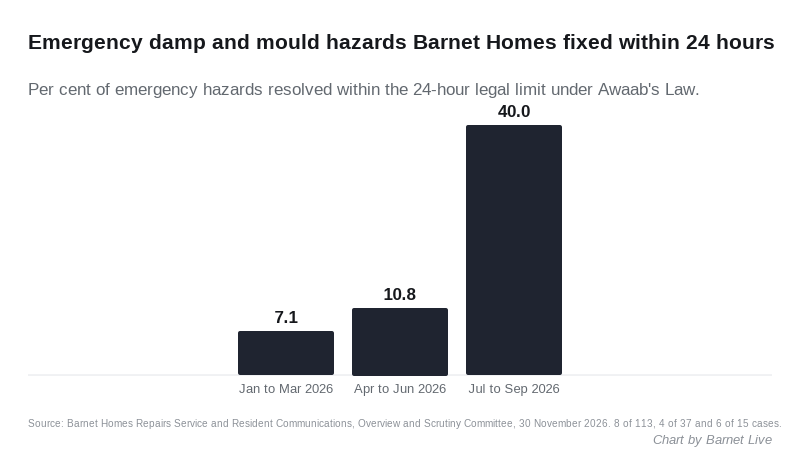
Barnet Homes fixed 6 of 15 emergency damp and mould hazards within the 24-hour legal limit this summer. Awaab's Law covers more hazards from 30 November.
Barnet Homes fixed 6 of 15 emergency damp and mould hazards in council homes within the 24-hour legal limit between July and September. That is 40%, up from 7.1% in the first three months of 2026. The figures come as Awaab’s Law extends to a much wider range of hazards on Monday 30 November.
They are in a report to Barnet’s Overview and Scrutiny Committee, which meets on 30 November. Barnet Homes manages the council’s homes. The report says its performance on the new legal measures “has not yet reached the required standard”, but is improving.
The damp and mould figures
Awaab’s Law first applied to damp and mould in social housing from 27 October 2025. Since then Barnet Homes has reported against new measures each quarter.
| Measure | Jan to Mar 2026 | Apr to Jun 2026 | Jul to Sep 2026 |
|---|---|---|---|
| Inspections done within 10 working days | 73.5% (341 of 464) | 93.2% (286 of 307) | 90.6% (174 of 192) |
| Emergency hazards fixed within 24 hours | 7.1% (8 of 113) | 10.8% (4 of 37) | 40.0% (6 of 15) |
| Urgent hazards fixed within 5 working days | 25.2% (60 of 238) | 20.1% (42 of 209) | 47.9% (45 of 94) |
| Routine damp repairs done on time | 68.8% (198 of 288) | 60.5% (321 of 531) | 71.1% (332 of 467) |
| Households moved out temporarily because of damp and mould | 5 | 1 | 12 |
The report blames early failures on too few decorators to meet the legal deadlines. Barnet Homes increased its decorators from two to six. On 4 May, 112 emergency and urgent mould jobs were overdue, out of 124 open. By 6 November that was down to four overdue out of nine, the report says. All four were waiting because staff could not get into the home.
Access is a large part of the problem. Between July and September, no one let staff in on 38.5% of visits to fix emergency hazards. The figure was 23.0% for urgent hazards.
What changes on 30 November
From 30 November, Awaab’s Law also covers:
- excess cold and excess heat
- falls
- structural collapse
- fire, electrical faults and explosions
- hygiene hazards
The report says Barnet Homes is recruiting for new roles and has trained repairs, contact centre and housing staff. It will also change how it handles leaks, so they are fixed before they cause damp, electrical or slip hazards. Its repairs timeframes change on the same day.
If a hazard cannot be fixed in time and the home is unsafe, Barnet Homes says it will move the household to other accommodation until the work is done.
Other repairs are faster
Ordinary repairs have improved sharply. The report’s summary lists these gains for the year to March 2026:
- non-emergency repairs done on time rose from 59.0% to 84.2%
- emergency repairs done on time rose from 94.1% to 96.3%
- the average routine repair went from 58 working days to 13
- satisfaction with repairs rose from 62.8% to 66.1%
Repairs complaints fell from 240 to 201 when the first halves of 2025/26 and 2026/27 are compared. Barnet Homes upheld 76.1% of them, up from 74.6%. That is above the 71.0% median for its group of seven London councils and housing bodies, the report says.
Damp and mould, water getting in and plumbing were the most common repairs behind upheld complaints from January to March 2026, the report says.
What it means for you
If you rent from Barnet Homes and have damp, mould or a leak, report it to Barnet Homes straight away and say if anyone in the home is vulnerable or unwell. Its staff now ask about vulnerability when you call, and those cases are reviewed within an hour.
Letting staff in when they come is the single biggest thing that speeds up the fix. From 30 November the same legal deadlines will apply to hazards such as broken heating in winter, dangerous wiring and serious trip risks.
The Overview and Scrutiny Committee meets at Hendon Town Hall at 7pm on 30 November.
Have your say