
Barnet's auditor says the council is not financially sustainable and has issued a statutory recommendation. A council tax rise of up to 30% is in the plan.
Overview
Barnet Council’s external auditor, Grant Thornton, has issued a statutory recommendation saying the council “is not financially sustainable” and must urgently carry out its recovery plan.
The plan leans heavily on a council tax rise above the usual 4.99% limit. The auditor says the council intends either a 30% rise in one year or 13.59% a year for three years. Neither has been agreed by the government or by councillors.
What the auditor found
The findings are in Grant Thornton’s Interim Auditor’s Annual Report for 2025/26. It went to the council’s Governance, Audit, Risk Management and Standards Committee on Thursday 26 November.
The auditor rated the council red, meaning significant weaknesses, in all three areas it examines:
- financial sustainability
- governance
- economy, efficiency and effectiveness, which covers procurement and contract management
It made one statutory recommendation and five key recommendations. The council’s cover report confirms those numbers.
A statutory recommendation is made under Section 24 and Schedule 7 of the Local Audit and Accountability Act 2014. The report says such a recommendation goes to the full council and “must be considered publicly”. It replaces a key recommendation Grant Thornton made about the council’s finances last year.
The money
The council cannot balance its books without Exceptional Financial Support from the government. That support lets it borrow, or use money from selling assets, to cover day-to-day spending.
The auditor’s figures:
| Exceptional support used in 2025/26 | £46m, most of it (£44m) borrowed |
| Budget gap in 2026/27 | £79.3m |
| Exceptional support the council expects to use in 2026/27 | £73m |
| Budget gap forecast for 2030/31 | £243.6m |
| General fund reserves, 31 March 2026 | £15m |
| Earmarked reserves, 31 March 2026 | £55.8m |
| Savings planned over five years | £19.3m |
The auditor says the savings targets “are low considering the size of the budget gap”. It adds that savings alone “would never be sufficient” to close it.
It also notes that trade unions have brought equal pay claims for more than 900 potential claimants. Their validity and size are not yet known. If they succeed, the auditor says they “could pose a material challenge” to the council’s finances.
Why council tax is central
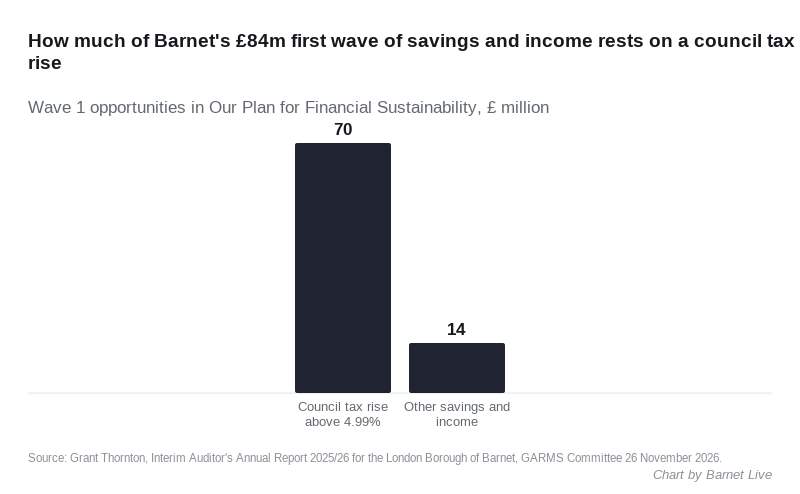
The council approved Our Plan for Financial Sustainability on 12 October. It looks for £200m of savings and income, with a first wave of £84m to be delivered by 31 March 2028.
Of that £84m, £70m is a council tax rise above 4.99% in 2027/28. The auditor says that idea is still at the “hypothesis” stage of the council’s own five-stage process. It says the government’s view, and the wider political picture, are uncertain and represent “a significant financial risk”.
What the auditor wants done
The statutory recommendation says the chief executive and senior officers should develop the ideas that could save money or raise income in 2027/28 by 31 January 2027. That is before the council sets its 2027/28 budget and council tax.
For the ideas that come later, each should have:
- a named officer responsible for it
- the money it is expected to bring in
- key milestones and delivery dates from 2027/28 to 2029/30
The auditor also says the detailed plans should reach councillors in time for proper scrutiny. That should include both “the minority administration and opposition”, so they understand why officers have put forward a higher council tax. Cabinet should get progress reports at least every three months.
What the council said
The council’s management “partly agree” with the recommendation, according to its response printed in the report. It says the October plan sets out its route to financial sustainability by March 2029.
The response says a significant council tax rise “would provide a sustainable contribution” to closing the gap. It adds that any rise above the limit needs approval from the Ministry of Housing, Communities and Local Government and from the full council. Each first-wave idea has a named chief officer and cabinet lead, it says, and Cabinet will get quarterly updates.
The other findings
The five key recommendations cover:
- the Housing Revenue Account, which pays for council housing. The auditor says its reserves are forecast to fall from £11.3m to £0.08m by March 2028.
- the lack of a detailed asset management plan. The council must produce one by March 2027.
- oversight of the council’s own companies
- the state of the council’s accounts. Audit opinions have been disclaimed under the national backstop every year since 2020/21, and the 2025/26 draft accounts needed significant redrafting.
- procurement and contract management. The auditor notes improvement, including a new Head of Procurement, but says there is no reliable dashboard for monitoring contracts.
The auditor also found differences between the interests declared on Cabinet members’ profile pages and those recorded in Cabinet minutes. It asks for better publication of councillors’ declarations.
There was some better news in the same papers. The auditor expects to give the 2025/26 pension fund accounts a qualified “except for” opinion, which the council’s cover report calls progress after disclaimed opinions in earlier years.
What it means for you
Nothing has changed on your bill yet. The rate for 2027/28 will be set when the council agrees its budget for that year.
A rise above 4.99% needs the government’s permission and a vote of the full council. On the auditor’s figures, the council is weighing a 30% rise in one go or 13.59% a year for three years. You can check your band on our Barnet council tax bands page.
The next point to watch is the January deadline. The auditor wants the 2027/28 savings and income ideas ready by 31 January 2027, before the budget is set.
Have your say