
Government has signed off Barnet's SEND and Alternative Provision Reform Plan. It funds 189 new specialist places in 2026/27, a £3.19m support programme and a £5.6m capital signal, with 5,044 children on EHCPs.
The Department for Education has approved Barnet’s three-year plan for special educational needs and disabilities. The council announced the sign-off on 7 October.
The plan, called Every Child Achieving and Thriving, runs from this school year to 2028/29. It comes with new money that has strict conditions attached, and it sets out where new specialist places will be created first.
The numbers behind it
The council says Barnet has 8,300 SEND pupils, and 5,044 of them hold an Education, Health and Care Plan (EHCP) as of April 2026. The plan summary, published on the Barnet Local Offer, presents the 8,300 figure as children and young people on SEND Support and lists the 5,044 EHCPs separately.
From the same summary:
- 51% of EHCPs are delivered in maintained mainstream schools
- 100% of EHCPs were issued within the 20-week legal limit
- requests for EHCPs rose 104% between 2020 and 2024
- the High Needs Block, which funds SEND, is under about £6m of overspend pressure
The plan says Barnet’s overall schools budget is not in deficit, so the borough “does not benefit from historic deficit write-off”. Recovering the £6m “requires a separate strategy”. The reform money cannot be used to close it.
Where the new places are
The summary calls 2026/27 “the urgent place-creation year”. It lists:
| Type of place | New places in 2026/27 |
|---|---|
| Primary special school | 36 |
| Secondary special school | 94 |
| Post-16 specialist | 49 |
| Secondary SEMH base in a mainstream school | 10 |
That is 189 places. SEMH stands for social, emotional and mental health needs. The plan says pressure is strongest at secondary and post-16, and that primary bases will shift towards SEMH and speech, language and communication needs over time. The Oakleigh and Mapledown estate programme is named as informing “the next wave”.
The plan does not expect demand for special school places to fall. It says the chance of any significant reduction “is considered to be marginal”.
The money
Three funding streams are described, each with different rules.
Experts at Hand grant. Barnet’s year-one allocation is about £3.2m. At least 80% (£2.56m) must go on direct delivery, with a maximum of 10% on administration and 10% on transformation. The projected three-year programme totals £3,191,508, split roughly a third per year.
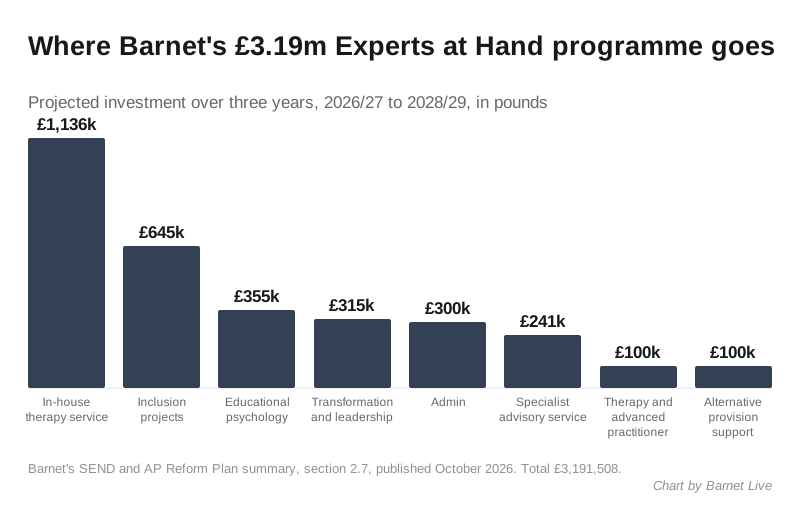
The largest line is an in-house therapy service at £1,136,000 (35.6%), followed by inclusion projects at £645,000 and the educational psychology service at £355,000. The plan says 67% of the total goes on therapy, inclusion projects and educational psychology capacity.
High Needs Capital. The 2026/27 “capital signal” for Barnet is £5.6m, for inclusion bases, specialist places and adaptations. Every scheme must evidence need, why earlier levels of support cannot meet it, and the effect on journey times.
Inclusive Mainstream Fund. This flows directly to schools, early years and post-16 settings. The council’s role is “planning, engagement and accountability”, and it cannot be used to offset the council’s High Needs overspend.
The summary is blunt about the limits: reform funding “cannot offset existing HNB deficits, fund provision already named in EHCPs, replace current provision, fill gaps or cover EHCP assessment costs”.
The case for doing it this way
The plan’s financial logic is to avoid “escalation into high-cost placements and long-distance transport”. Its planning assumption is that transport for a pupil placed in the borough costs about £7,000 a year, against about £22,000 for an out-of-borough placement.
The delivery model has three phases:
- 2026/27, build and test: agree school clusters and access routes, commission the specialist support service, confirm the pipeline of new places, start DfE monitoring
- 2027/28, embed and scale: roll out the locality cluster model and standards for support bases
- 2028/29, assure and refine: confirm the full Team Around the Cluster model and set the next wave of investment
Cllr Pauline Coakley Webb, Cabinet Member for Family Friendly Barnet, said the approval marked “an important milestone as we move forward into implementation”. She added: “Importantly, this is an evolving plan rather than a fixed document.”
According to the council, the DfE found the plan had “a clear, reform-aligned vision, a strong understanding of local needs” and a delivery approach focused on mainstream inclusion and financial sustainability.
What it means for you
- Parents of children with an EHCP: nothing in the plan changes your child’s existing provision. The money is for new capacity, not for replacing what is already named in a plan.
- Parents waiting for assessment: the plan aims to get specialist advice into schools earlier, through the Experts at Hand service, so that fewer children need a statutory assessment to get help. It does not fund assessments themselves.
- Families facing a long journey: the new secondary and post-16 places are meant to keep more children in the borough. Which schools gain them has not been published yet.
- Schools: the Inclusive Mainstream Fund goes to settings directly. Clusters and access routes are to be agreed this year.
Barnet’s recent school results and inspections are covered in our reports on Queen Elizabeth’s School’s Ofsted report and Chalgrove Primary. Term dates for 2026/27 are on our school term dates page.
We will report where the 189 places go once the council names the schools.
Have your say